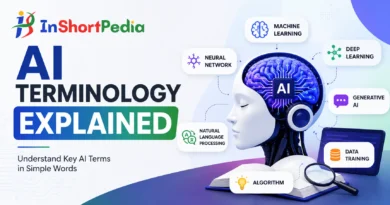

Machine Learning, Deep Learning, and Neural Networks: Key Differences
AI is behind many things in our daily life – from Netflix suggestions to driverless cars. But perhaps you have read aboutMachine Learning (ML),Deep Learning (DL) andNeural Networks (NNs). They are sound-alikes, but each operates on its own principles.
In this article, we are going to discuss Machine Learning vs Deep Learning vs Neural Network in the simplest of words and compare the three, to help you use them effectively.
For more basics, check out our guide onArtificial Intelligence.
1. What is Machine Learning?
Machine Learning is a branch of AI where we use computers to do things for which they weren’t explicitly told to do.
Key Points:
- Learns from data: The more data you provide, the better it gets.
- Uses algorithms: Regression Decision Trees Clustering
- Wants oversight: You do feature selection and parameter tuning by hand.
Real-life Examples:
- Gmail spam filters
- Product recommendations on Amazon
- Credit scoring for banks
Tips for Beginners:
- Experiment with Scikit-learn or TensorFlow Lite to prototype simple models.
- For experiments, use structured data such as Excel or CSV files.
2. What are Neural Networks?
Neural Networks aremodels inspired by the human brain. It process information using layers of “neurons,” which makes them very good at recognizing patterns.
How it Work:
- Input layer: Accepts raw data.
- Hidden layers: Transform the data in complex ways.
- Output layer: Gives the final result or prediction.
Example:
When Facebook tags your friend in a photo, a neural network detects eyes, nose, and other facial features.
Tips for Beginners:
- UseKeras to experiment with neural networks.
- Start with1–2 hidden layers before trying deeper networks.
3. What is Deep Learning?
Deep Learning is aspecial kind of Machine Learning. It usesdeep neural networks (many layers) to analyze complex data like images, sound, or text.
Key Points:
- Automatic feature learning: You don’t need to pick features manually.
- Needs computing power: It works best with GPUs or TPUs.
- Works with big data: Performance improves as data grows.
Real-life Examples:
- Siri and Alexa voice assistants
- Self-driving cars (Tesla, Waymo)
- Google Translate
Tips for Beginners:
- UsePyTorch orTensorFlow for deep learning projects.
- Trycloud AI services like Google Cloud AI, AWS SageMaker, or Azure AI for heavy computing tasks.
Machine Learning vs Deep Learning vs Neural Networks: Main Differences
| Feature | Machine Learning | Neural Networks | Deep Learning |
| Definition | Computers learn using algorithms | Brain-inspired model | Advanced ML using deep neural networks |
| Data Requirement | Works with small datasets | Medium to large datasets | Needs massive datasets |
| Feature Handling | Manual feature selection | Some automation | Fully automatic |
| Performance | Good for simple tasks | Better for pattern recognition | Best for complex data |
| Examples | Spam filters, fraud detection | Image recognition, text basics | Self-driving cars, speech recognition |
Quick Advice:
- Use Machine Learning(ML) for small data and simple problems.
- Use Deep Learning(DL) for unstructured data and large datasets.
- Use Neural Networks(NNs) to explore brain-inspired models.
Tools and Resources
- Wikipedia & Google Knowledge Graph – Learn concepts quickly.
- Kaggle – Access datasets and join competitions.
- Hugging Face – Pre-trained models for NLP and computer vision.
- Yelp Dataset Challenge – Practice with real-world review data.
Best Practices for Beginners
- Learn Python – It’s the most common language for ML/DL.
- Start small – Build a spam filter before trying self-driving cars.
- Use open datasets – Try MNIST (digit recognition) or CIFAR-10 (image classification).
- Use cloud services – Avoid buying expensive GPUs at first.
- Experiment often – Tweak models, visualize results, and check accuracy.
Quick Summary / Checklist
✅ Machine Learning = Algorithms + smaller datasets + manual features
✅ Neural Networks = Brain-inspired models + foundation of DL
✅ Deep Learning = Multi-layer networks + unstructured big data
✅ Tools to try = Scikit-learn, TensorFlow, PyTorch, Keras
✅ Best for = From spam filters to self-driving cars
Conclusion
Machine Learning, Deep Learning, and Neural Networks are related, but all three are different.
Look at МL as the general field, Neural Networks its component parts, and DL in advanced interface tackling complex jobs.
Understanding these differences helps you choose the right technology, whether you’re building a chatbot, an image recognition system, or a voice assistant.