
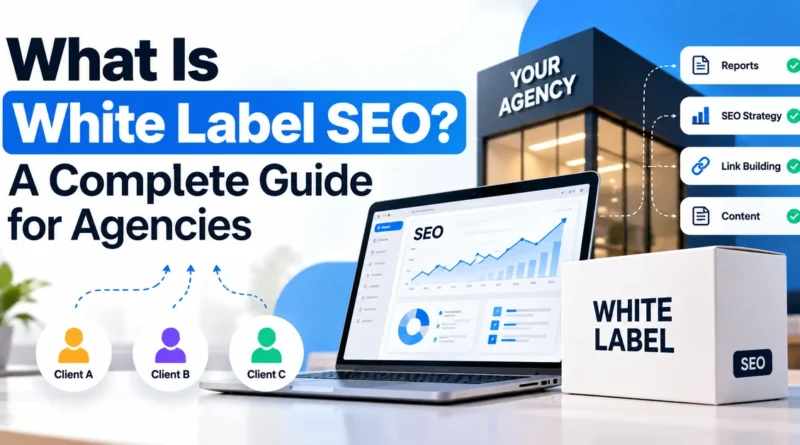
What Is White Label SEO? A Complete Guide for Agencies
White label SEO is a business model where an SEO provider does the work for your client, and you deliver it under your own agency name. The client deals only with you. The provider stays in the background and handles audits, content, link building and reports.
Agencies use it to sell SEO without hiring a full team. It works well when you set clear standards and check the work. It fails when the agency treats the provider as a black box and sends reports it has not read.
How White Label SEO Works
There are three parties in the setup:
- Your agency owns the contract, the price and the client relationship
- The white label provider does the SEO work at a wholesale rate
- The client pays you and sees only your brand
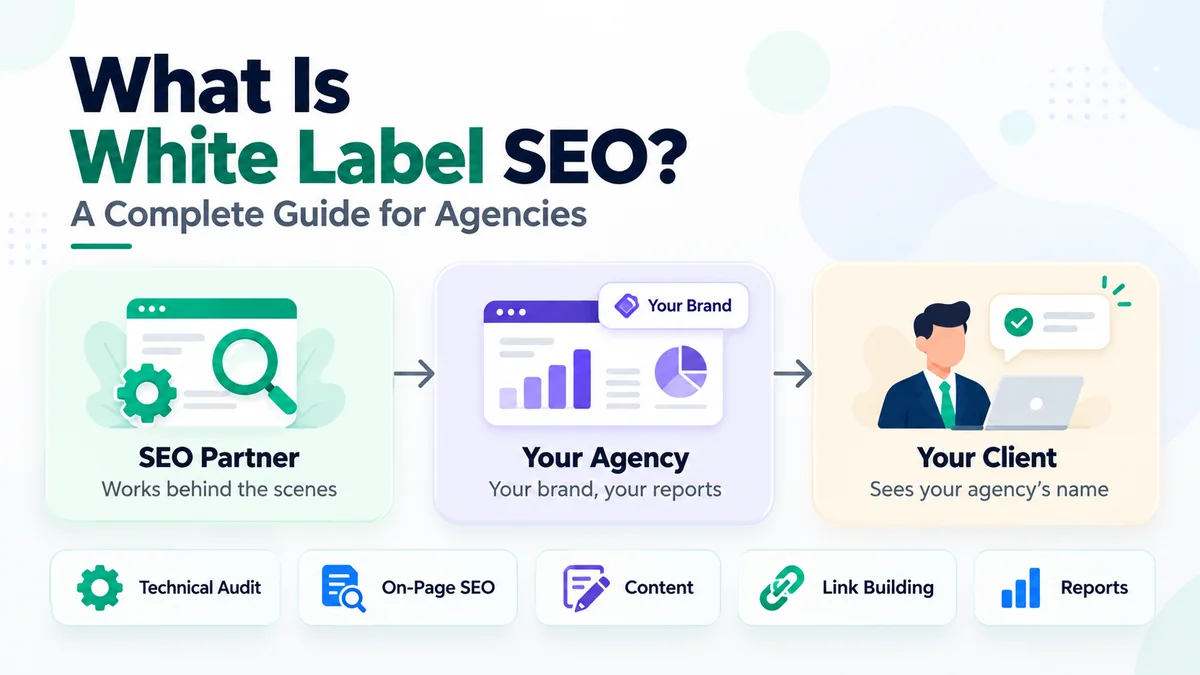
The usual flow looks like this:
- You sign the client and set the monthly retainer.
- You share the website, goals, target countries and keywords with your provider.
- The provider runs the audit and starts the work.
- Reports come back with your logo and your colours.
- You review them, add your own comments and present them to the client.
Step 4 is where the quality gap shows. A branded report is easy to produce. A report that explains what changed and why takes real effort, so ask to see a sample before you sign.
What Services Can You White Label?
Most providers sell SEO as separate parts. You can buy the full package or only the pieces you lack.
- Technical SEO covers crawl errors, indexing, site speed, Core Web Vitals and schema markup
- On page SEO covers title tags, meta descriptions, headings and internal links
- Keyword research and content planning based on search intent
- Content writing for blogs, service pages and landing pages
- Link building and digital PR
- Local SEO including Google Business Profile and citations
- International SEO such as hreflang tags and country specific pages
- Reporting through branded dashboards
White Label SEO vs Reseller vs Referral vs In House
These terms get mixed up. The difference comes down to who does the work and who owns the client.
| Model | Who does the work | Who owns the client | Brand shown to client | Margin |
|---|---|---|---|---|
| White label | Partner, behind the scenes | You | Yours | Medium to high |
| Reseller | Partner, often visible | Shared | Partner’s tools or brand | Medium |
| Referral | Partner, direct to client | Partner | Partner’s | Low (a fee or commission) |
| In house team | Your employees | You | Yours | Highest once the team is full |
White label sits in the middle. You get a fast start like a referral, but you keep the client and the brand like an in house team.
White Label SEO vs Traditional SEO Outsourcing
Traditional outsourcing means you hire someone for tasks. They may talk to your client, use their own report format or mention their own business. White label means the provider follows your branding, your communication style and your timelines.
For agencies, the real difference is control. With white label you decide what the client sees. With plain outsourcing, you often do not.
How Much Does White Label SEO Cost?
Prices vary by provider, scope and how competitive the client’s industry is. Providers usually charge in one of three ways:
| Pricing model | How it works | Best for |
|---|---|---|
| Monthly retainer | Fixed fee per client for a set list of tasks | Ongoing campaigns |
| Per project | One time fee, such as an audit or site migration | Short, defined work |
| Per deliverable | Fee per article, link or page | Agencies that want to control volume |
Cheap pricing is a warning sign. Low rates often mean thin content, bought links and slow replies.
A Margin Example in Rupees
These numbers are illustrative, not a market rate. They show how to work out your real profit.
| Item | Per month |
|---|---|
| Retainer you charge the client | $1,000 |
| Provider cost | $600 |
| Gross margin | $400 (40%) |
| Your account management time | $100 |
| Tools and reporting software | $50 |
| Net margin | $250 (25%) |
Many agencies quote a 40% margin and forget their own time. Count management hours and tools before you set a price. If net margin falls under 20%, raise the retainer or reduce the scope.
Pros and Cons of White Label SEO
| Pros | Cons |
|---|---|
| Start selling SEO without hiring | Less control over daily tasks |
| Costs grow only as clients grow | Quality differs between providers |
| Faster onboarding for new clients | Your reputation carries their mistakes |
| Access to tools and specialists | Margins shrink if you price badly |
| Easy to add more clients | Delays in replies reach your client |
Who Should Use White Label SEO?
- Web design agencies that build sites and get asked “can you also rank it?”
- PPC and social media agencies that want to add organic search to a client package
- Freelancers who need a team behind them for bigger projects
- Branding and content agencies that already write but lack technical SEO skills
If you already have a full SEO team and spare capacity, you do not need it.
What Is White Label Local SEO?
White label local SEO is the same model focused on local search results such as Google Maps and the local pack. Work includes Google Business Profile setup, local citations, review responses and location pages. It suits agencies serving dentists, restaurants, clinics and other location based businesses.
White Label SEO for Global Clients
If you serve clients in more than one country, ask your provider about these points before you sign:
- Language and spelling: can they write in UK, US or Australian English as needed?
- Country targeting: do they handle hreflang tags, country folders and separate Google Business Profiles?
- Time zones: will they join client calls or at least reply inside your working hours?
- Data protection: if a client has users in the EU, check how the provider handles client data, and sign a data processing agreement where required.
- Local link sources: links for a UK site should come from relevant UK sites, not a generic pool.
Risks to Watch
- Link spam: Google’s spam policies list link schemes as a violation. A manual action lands on your client’s site, not on the provider.
- Scaled content: Google’s spam policies also cover content produced in bulk mainly to rank. Read every article before it goes live.
- Account access: keep ownership of the client’s Google Search Console, Analytics, and Business Profile. Never let the provider own them.
- Guaranteed rankings: Google’s own guidance on hiring an SEO says no one can guarantee a first position. Never promise it in a proposal.
How to Choose a White Label SEO Provider
- Ask for sample reports and sample articles. Read them as a client would.
- Ask how they build links. If they cannot explain where links come from, walk away.
- Check communication. Find out who your contact is and the usual reply time.
- Run a small trial. Use one client or one project before moving everything.
- Get terms in writing. Cover confidentiality, ownership of work and what happens if you leave.
- Check agency experience. Providers who work only with agencies understand branding and reporting needs.
How to Start Offering White Label SEO: 7 Steps
Follow these steps in order. Most agencies lose money in this model because they skip step 3 or step 5.
Step 1: Pick a Small, Clear Package
Do not sell “full SEO” on day one. Start with one package you can explain in two lines. For example:
- Starter: technical audit, on page fixes for 10 pages, 4 blog posts a month, monthly report
- Growth: everything in Starter, plus 4 to 6 quality links a month and keyword tracking
Write down what is included, what is not, and how many revisions the client gets. A clear scope stops arguments about “extra work” in month three.
Step 2: Shortlist Two or Three Providers
Ask each provider for the same four things:
- A price list with what each plan includes
- A sample report with the logo removed
- Two or three sample articles on topics you pick
- A short written answer on how they build links
Reading the link answer tells you a lot. A good provider names the kinds of sites they approach and how. A weak one says “high authority links” and nothing more. Also check how fast they reply to your questions. That speed will be the same when a client is upset.
Step 3: Run a Paid Trial
Never test a new provider on your biggest client. Pick a small client or a single project, such as one audit or four articles, and pay for it.
Score the trial on a simple sheet:
| What to check | What good looks like |
|---|---|
| Audit | Finds real issues with clear fixes, not a generic tool printout |
| Articles | Accurate, original, matches search intent, needs light edits only |
| Reporting | Numbers match your own Google Search Console and Analytics |
| Deadlines | Delivered on the agreed date |
| Communication | Questions answered within one working day |
If the trial fails on two or more rows, move to your next provider. It is cheaper to lose $200 on a trial than to lose a client worth $1,000 a month.
Step 4: Set Your Price
Work out your price from the bottom up:
- Provider cost for the package
- Your account management hours (calls, reviews, emails) at your hourly rate
- Tools you pay for, such as rank tracking and reporting software
- Your target net margin, which should be at least 25%
For example, if the provider costs $600, your time is $100 and tools are $50, your total cost is $750. To keep a 25% net margin, divide by 0.75. That gives a retainer of $1,000.
Then compare with other agencies in your market. If you are far above them, reduce scope instead of cutting the price.
Step 5: Build a Review Checklist
Everything the provider sends should pass through you before it reaches the client. Keep the checklist short so people actually use it:
- Keywords: do they match what the client sells and what buyers search?
- Facts: are numbers, names and claims correct and sourced?
- Originality: is the content written for people, not copied or padded?
- Links: are they from real, relevant sites? Open a few and look.
- Report numbers: do they match Search Console and Analytics?
- Brand: is the client’s name, your logo and your tone correct?
Spending 30 to 45 minutes a week on this protects the client from a penalty and protects your reputation.
Step 6: Standardise Your Reporting
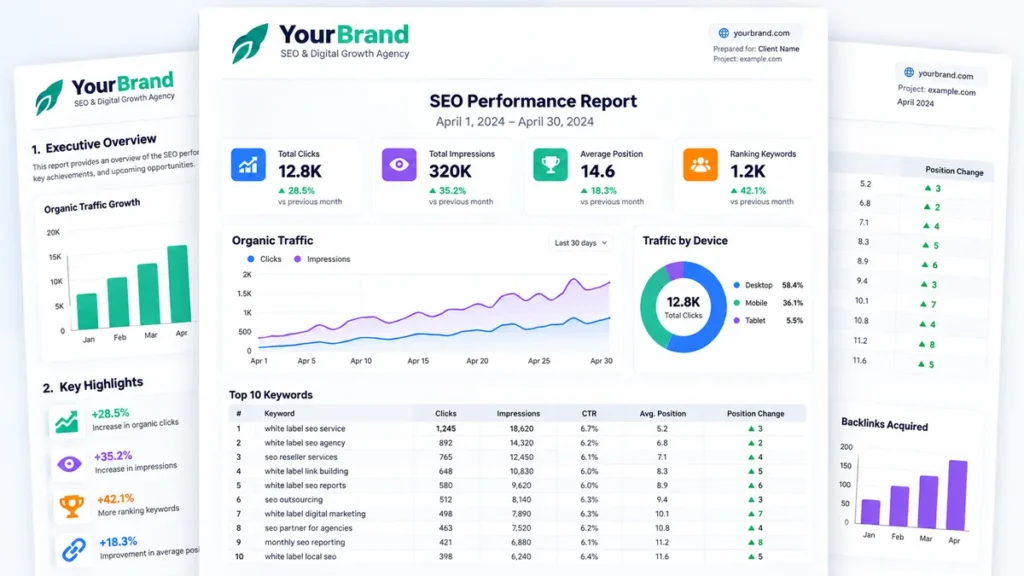
Use one report format for every client so you can produce it fast and clients know what to expect. Include:
- Organic traffic compared with last month and last year
- Keyword rankings for the main 10 to 20 terms
- Conversions such as leads, calls or sales from organic search
- Work done this month in plain language
- Plan for next month in three or four lines
Add one short paragraph written by you. Clients value a person explaining the numbers more than a graph.
Step 7: Review Every Quarter
Hold a review with your provider every three months, and check these points:
Is the cost still right for the results?
Did traffic and conversions move in the right direction?
Were deadlines met?
Did any article or link need fixing after delivery?
Common Mistakes Agencies Make With White Label SEO
Most white label problems come from the agency side, not the provider. These are the six mistakes that cost agencies clients, and how to avoid each one.
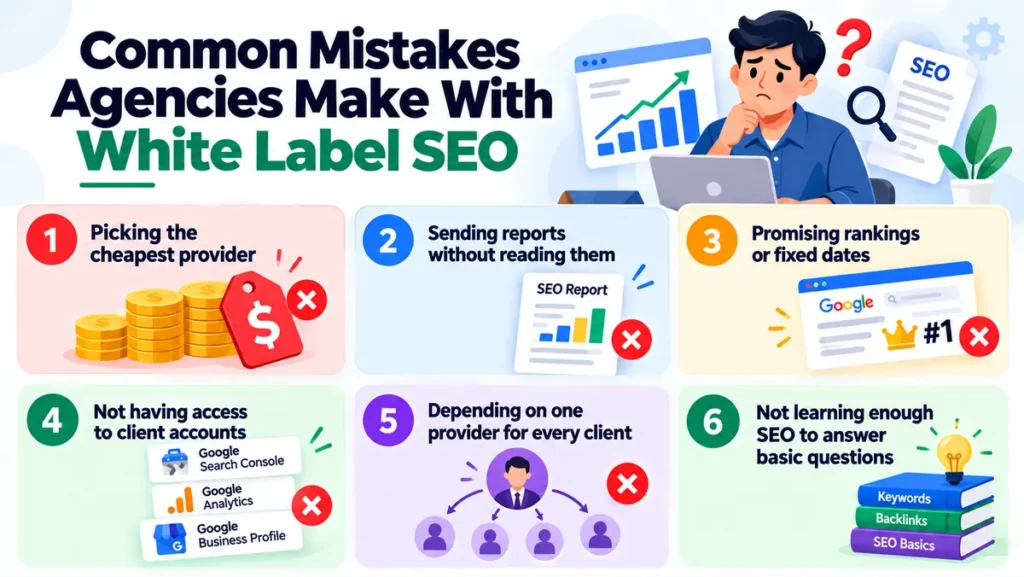
1. Picking the cheapest provider
A low price usually means the work is cut somewhere else: thin articles, bought links or slow replies. If a provider charges $120 for what others charge $350 for, ask what is missing.
Fix: compare providers on the same list of deliverables, then judge by the trial results, not the price.
2. Sending reports without reading them
A wrong number or a vague summary in a report reaches your client with your name on it. Clients notice quickly when a report says traffic grew and their own Google Analytics shows it fell.
Fix: match the traffic and ranking numbers against Search Console and Analytics before every report goes out.
3. Promising rankings or fixed dates
Nobody controls Google’s results, and Google’s own guidance on hiring an SEO says no one can guarantee a first position. A promise like “page one in 60 days” only creates a problem for month three.
Fix: promise activity and reporting, such as audits, pages fixed and articles published. Set targets as ranges, not guarantees.
4. Not having access to the client’s Search Console and Analytics
If the provider owns these accounts, you lose the data when you change providers. You also cannot check their numbers.
Fix: the client should own Google Search Console, Google Analytics and the Google Business Profile. Add your agency and the provider as users with the lowest access level they need.
5. Depending on one provider for every client
If that provider gets slow, raises prices or shuts down, every client is affected at once.
Fix: keep a second provider on a small trial project, so you can switch within days.
6. Not learning enough SEO to answer basic questions
You do not need to be an expert. You do need to explain why a keyword was chosen, what a backlink is and why results take time. If you cannot, clients stop trusting you and start asking who is really doing the work.
Fix: ask your provider for a short monthly call and learn the five or six terms clients ask about most.
Quick check before you sign a client
| Question | If the answer is no |
|---|---|
| Have I read the last report fully? | Do not send it |
| Does the client own their Google accounts? | Fix this before work starts |
| Does my proposal avoid ranking guarantees? | Rewrite the proposal |
| Do I have a backup provider? | Run a small trial this month |
| Can I explain the plan in plain words? | Book a call with your provider |
How Long Does White Label SEO Take to Show Results?
Most campaigns take 3 to 6 months to show clear movement in rankings and organic traffic. Competitive industries, new websites and sites with technical problems can take longer. Leads and sales usually follow traffic, so they often move later still.
The reason is simple. Google needs time to crawl new pages, judge them and compare them with competitors who have had years to build links. Content published in month one rarely reaches its best position before month four.
What to expect month by month
| Period | What is usually happening | What you can report |
|---|---|---|
| Month 1 | Audit, keyword research, fixing technical issues | Issues found and fixed, keyword plan |
| Months 2 to 3 | New and updated pages go live, first links built | Pages published, early impressions in Search Console |
| Months 3 to 4 | Pages start to index and rank for smaller keywords | Rising impressions, first ranking gains |
| Months 4 to 6 | Rankings move for main keywords, traffic grows | Organic traffic and ranking growth |
| Month 6 and after | Gains build on each other if content and links continue | Leads, calls or sales from organic search |
These are typical patterns, not promises. A local business in a small town can move faster than a national brand fighting large competitors.
What speeds results up or slows them down
- Site age and authority: an older site with some links moves faster than a brand new one
- Competition: a “plumber in a small town” keyword is easier than “best CRM software”
- Technical health: crawl errors and slow pages hold back every other effort
- Content quality and speed: regular, useful pages work better than a large batch once
- Client response time: delays in approvals and site access push everything back
How to set this expectation in the sales call
Say it before the client signs, and put it in the proposal. For example:
“In the first month we fix the foundation. You will see early signals in months two and three, and clear ranking and traffic movement usually starts between months three and six. We will report activity every month, so you can see the work even before the results arrive.”
This does two things. It sets a fair timeline, and it gives the client something to see every month, which keeps them from leaving at month two.
Report progress, not just rankings
Early reports should not depend on rankings alone. Include:
- Pages fixed, published and indexed
- Impressions and clicks in Search Console
- Keywords that moved into the top 20
- Technical issues resolved
If you agree on these measures in advance, a slow month does not feel like a failure to the client.
FAQ
What is white label SEO in simple words?
It is when a partner does SEO for your client and you present it as your own work. The client sees your brand, reports and contact details. The partner stays hidden.
Is white label SEO legal?
Yes. It is a common business model. The key is honesty about results and methods, and a contract that covers confidentiality and data.
How much should I charge for white label SEO?
Add your provider cost, your management time, tools and a margin of at least 25% to 40%. Then check that the price fits your market.
What is the difference between white label SEO and reselling SEO?
In white label, the work carries your brand and you own the client. In reselling, the partner’s tools or name may still appear and the relationship is often shared.
Can white label SEO hurt a client’s website?
Yes, if the provider uses paid links or low quality content. Ask about methods, review the work and keep control of the client’s accounts.
Is white label SEO worth it for small agencies and freelancers?
Often yes, because you avoid hiring costs and can start selling quickly. It works best when you keep control of strategy and client communication.