Never Start a Business Until You Understand These 7 Financial Metrics
Most new business owners spend weeks on their logo, their website, and their product packaging. Very few spend even one hour learning the financial metrics that decide whether the business survives its first year.
This is not a finance degree article. It is a plain English guide to the seven numbers every founder, freelancer, or small business owner must understand before spending a single rupee on a new business. Each metric comes with its formula, a simple worked example, and a note on why it actually matters in real business decisions.
By the end, you will know how to calculate Return on Investment, Return on Advertisement Spend, Working Capital, Profit Margin, EBITDA, Break Even Point, and Revenue Run Rate, and how these numbers connect to each other.
Why Financial Metrics Matter More Than a Great Idea
A good product idea gets you a customer. Good financial understanding keeps the business alive long enough to get a second, third, and hundredth customer. Founders who skip financial planning often discover too late that they were profitable on paper but out of cash in the bank, or that their advertising spend was quietly eating their margins.
These seven metrics form the backbone of business financial literacy. They apply equally to a home baker, a Shopify store owner, an Ayurvedic brand, a SaaS founder, or a local service business. Once you understand how they connect, budgeting, pricing, and fundraising conversations become far easier.
1. Return on Investment (ROI)
Return on Investment tells you how much profit you earned compared to what you spent. It is the most basic profitability ratio in business finance, and every other metric on this list eventually feeds back into it.
Formula
ROI = (Net Profit from Investment ÷ Cost of Investment) × 100
Example
Suppose you invest ₹2,00,000 to launch a new product line. Over six months, that product line brings in ₹2,80,000 in net profit after covering all costs.
ROI = (2,80,000 ÷ 2,00,000) × 100 = 140%
A 140% ROI means you earned back your investment and made an additional 1.4 times profit on top of it.
Why it matters
ROI helps you compare unrelated investments on equal footing. It does not matter if you are comparing a new machine, a marketing campaign, or a new hire. As long as you can measure cost and return, ROI gives you a single number to judge the decision. A business that tracks ROI regularly rarely wastes money on ideas that look exciting but do not pay back.
2. Return on Advertisement Spend (ROAS)
Return on Advertisement Spend is a narrower cousin of ROI, focused only on marketing and advertising activity. Any founder running Google Ads, Meta Ads, or influencer campaigns needs to track this weekly, not yearly.
Formula
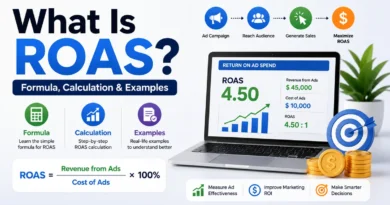
ROAS = Revenue Generated from Ads ÷ Amount Spent on Ads
Example
You spend ₹50,000 on a Meta Ads campaign for your online store. The campaign directly generates ₹2,25,000 in sales.
ROAS = 2,25,000 ÷ 50,000 = 4.5
This is usually written as a 4.5:1 ROAS, meaning every rupee spent on ads returned ₹4.5 in revenue.
Why it matters
ROAS is a revenue number, not a profit number, so it can look impressive while your business still loses money once product cost, shipping, and returns are counted. A general benchmark used by many D2C brands is that a ROAS below 2:1 is often unprofitable once true costs are included, though the exact break even ROAS depends on your profit margin. Track ROAS alongside profit margin, never in isolation.
3. Working Capital
Working capital is the money available for your day to day operations, such as paying suppliers, staff salaries, and rent, without touching long term assets or loans.
Formula
Working Capital = Current Assets − Current Liabilities
Current assets include cash, inventory, and receivables due within a year. Current liabilities include short term loans, unpaid supplier bills, and other dues within a year.
Example
Your business has ₹8,00,000 in current assets, which includes cash, stock, and pending customer payments. Your current liabilities, including supplier dues and short term loans, add up to ₹5,00,000.
Working Capital = 8,00,000 − 5,00,000 = ₹3,00,000
Why it matters
Positive working capital means you can cover near term obligations without borrowing more or panicking during a slow sales month. Many profitable businesses fail not because they lack profit, but because they run out of working capital when a big customer delays payment or a bulk stock purchase drains their cash reserve. This is why working capital management is treated as a survival metric, not just an accounting entry.
4. Profit Margin
Profit margin shows how much of every rupee in sales actually turns into profit. There are three common versions: gross margin, operating margin, and net profit margin. For a founder starting out, net profit margin is the most useful starting point.
Formula
Net Profit Margin = (Net Profit ÷ Total Revenue) × 100
Example
Your business earns ₹12,00,000 in total revenue for the year. After paying for goods, salaries, rent, taxes, and every other expense, your net profit is ₹1,80,000.
Net Profit Margin = (1,80,000 ÷ 12,00,000) × 100 = 15%
Why it matters
Two businesses can have identical revenue and completely different financial health depending on their margin. A business earning ₹50 lakh in revenue with a 5% margin makes less actual profit than one earning ₹20 lakh with a 20% margin. Profit margin is the number that tells you whether your pricing strategy and cost structure actually work, not just whether sales are growing.
5. EBITDA (Earnings Before Interest, Tax, Depreciation, and Amortization)
EBITDA measures how profitable your core business operations are, before the effect of financing decisions, tax rules, and accounting adjustments for asset value. It is widely used by investors to compare companies of different sizes and capital structures on a level playing field.
Formula
EBITDA = Net Profit + Interest + Taxes + Depreciation + Amortization
Example
Your business reports a net profit of ₹6,00,000 for the year. During that year, you paid ₹1,00,000 in loan interest, ₹80,000 in taxes, and recorded ₹40,000 in depreciation on equipment.
EBITDA = 6,00,000 + 1,00,000 + 80,000 + 40,000 = ₹8,20,000
Why it matters
EBITDA strips away the noise of loans, tax rates, and asset accounting so you can judge how well the actual operations are performing. Investors, lenders, and business buyers rely heavily on this number when evaluating a company, because it reflects the health of the core business rather than how it is financed. If you plan to raise funding or take a business loan later, expect EBITDA to come up early in the conversation.
6. Break Even Point
The Break Even Point is the exact level of sales at which your business stops losing money and starts making a profit. Below this point, every sale still results in a loss. Above it, every additional sale adds directly to profit.
Formula
Break Even Point (in units) = Fixed Costs ÷ (Selling Price per Unit − Variable Cost per Unit)
Example
Your fixed costs, such as rent and salaries, total ₹3,00,000 per month. You sell a product for ₹500 per unit, and the variable cost to produce each unit is ₹300.
Break Even Point = 3,00,000 ÷ (500 − 300) = 1,500 units
You need to sell 1,500 units every month just to cover your costs. Every unit sold beyond that adds ₹200 in profit.
Why it matters
Knowing your break even point before launch tells you whether your business model is realistic. If your break even point requires selling more units than your market can absorb, you know to fix your pricing or cost structure before you spend a single rupee, not after six months of losses.
7. Revenue Run Rate
Revenue Run Rate estimates your annual revenue based on a shorter, recent period of performance. It is especially useful for new or fast growing businesses that do not yet have a full year of sales history.
Formula
Annual Run Rate = Revenue in a Given Period × Number of Periods in a Year
Example
Your business earned ₹4,00,000 in revenue last month.
Annual Run Rate = 4,00,000 × 12 = ₹48,00,000
Based on current momentum, your business is on pace for ₹48 lakh in annual revenue.
Why it matters
Run rate is a projection, not a guarantee. It works best in stable, non seasonal businesses and can be misleading for businesses with festive spikes, one time bulk orders, or strong seasonality. Still, it gives founders and investors a quick, forward looking snapshot of momentum without waiting an entire year for confirmation.
How These Metrics Work Together
None of these numbers exist in isolation.
- ROAS tells you if your marketing spend is efficient, but profit margin tells you if that spend actually leaves you with profit.
- Break even point tells you the minimum sales needed to survive, and revenue run rate tells you whether you are trending toward or away from that number.
- Working capital keeps the business running day to day, while EBITDA and ROI tell you whether the business is worth running at all.
A founder who tracks all seven together builds a full financial picture, rather than chasing a single vanity metric like revenue growth while ignoring cash flow or margin.
What a Standard Business Finance Article Should Include
If you are building content around business finance, personal finance, or startup planning topics, a well structured article usually contains the following elements to satisfy both readers and search engines.
- A clear, benefit driven title that states what the reader will learn or avoid.
- A short introduction that states the problem and promises a specific outcome within the first few lines.
- Definitions in plain language before introducing any formula or technical term.
- A formula for every metric or concept, written in a simple, readable format.
- A real world worked example using realistic numbers, ideally in the reader’s own currency.
- A “why it matters” explanation connecting the concept back to a real business decision.
- Semantic and related keywords woven naturally through headings and body text, not stuffed artificially.
- Internal links to related articles or tools on your own site, placed where they add genuine value.
- External links to credible, non competing sources when citing data or standards.
- A short FAQ section answering common follow up questions in the reader’s own words.
- A conclusion or action step that tells the reader what to do next.
- Meta title and meta description written for search intent, not just keyword stuffing.
Frequently Asked Questions
What is the difference between ROI and ROAS?
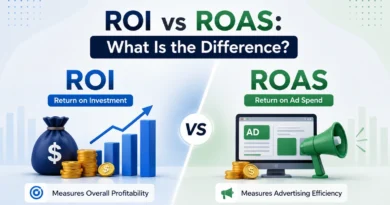
ROI measures return across any type of investment, including equipment, hiring, or product development. ROAS measures return specifically from advertising spend and is calculated using revenue, not profit.
Is a higher EBITDA always better?
A higher EBITDA generally signals stronger core operations, but it should always be read alongside net profit, since EBITDA excludes real costs like interest and tax that a business still has to pay.
How is working capital different from profit?
Profit is what remains after all expenses are subtracted from revenue over a period of time. Working capital is the cash and short term assets available right now to pay near term bills. A business can be profitable and still run out of working capital.
Why does break even point matter before starting a business?
It tells you the minimum sales volume needed to avoid losses, which helps you judge whether your pricing, costs, and target market can realistically support the business.
Can revenue run rate be misleading?
Yes. Run rate assumes your most recent period repeats consistently across the year, which is rarely true for seasonal businesses or businesses with one time large orders.
Final Thought
Starting a business without understanding ROI, ROAS, working capital, profit margin, EBITDA, break even point, and revenue run rate is like driving without a fuel gauge. You might move forward for a while, but you will not see the empty tank coming until it is too late.
Learn these seven numbers, apply them to your own business plan before you launch, and revisit them every month once you are live. They will not guarantee success, but they will stop you from failing for reasons that were entirely avoidable.