ROI vs ROAS: What Is the Difference?
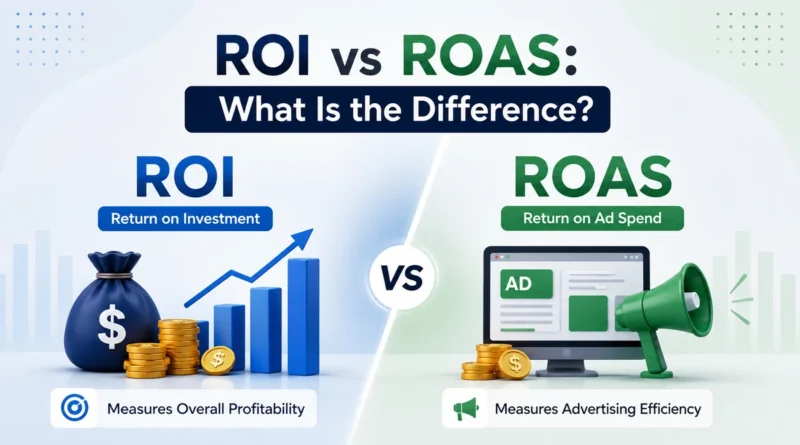
When you run ads or invest money into a business, two numbers keep coming up: ROI and ROAS. People often use these terms as if they mean the same thing, but they answer different questions. ROAS tells you how much revenue your ad spend generated. ROI tells you whether the business actually made a profit after all costs. Mixing up the two can lead to wrong decisions, like scaling a campaign that looks great on paper but is quietly losing money.
This article breaks down what each metric means, how to calculate them, and when to use one over the other.
What Is ROI?
ROI stands for Return on Investment. It measures the overall profitability of any investment, not just advertising. This includes ad spend, but also product cost, shipping, salaries, software, and any other expense tied to the campaign or business activity. Here is formula to calculate ROI.
ROI Formula
ROI = (Net Profit / Total Cost) x 100
Net profit here means revenue minus every cost involved, not just the ad spend. Total cost includes everything you spent to generate that revenue.
What ROI Tells You
ROI gives a full picture of financial performance. It answers the question: after paying for everything, did I actually make money, and how much. Because it accounts for all expenses, ROI is the number that matters most when deciding whether a product, campaign, or business line is worth continuing.
What Is ROAS?
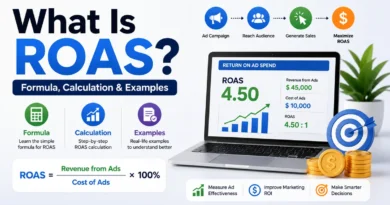
ROAS stands for Return on Ad Spend. It only looks at the relationship between money spent on ads and revenue generated from those ads. It does not consider product cost, operational expenses, or profit margins.
ROAS Formula
ROAS = Revenue from Ads / Ad Spend
The result is usually shown as a ratio, such as 4x, meaning four rupees earned for every one rupee spent on ads.
What ROAS Tells You
ROAS answers a narrower question: is this ad campaign generating revenue efficiently. It is useful for comparing performance across campaigns, ad sets, or platforms, and for making quick optimization decisions like pausing an underperforming ad or increasing budget on a winning one.
ROI vs ROAS: Key Differences
| Aspect | ROI | ROAS |
|---|---|---|
| Full form | Return on Investment | Return on Ad Spend |
| What it measures | Overall business profitability | Ad revenue efficiency |
| Includes all costs | Yes, all expenses | No, only ad spend |
| Output format | Percentage | Ratio, such as 4x |
| Scope | Business or campaign level | Ad campaign level only |
| Best used for | Deciding if the business is profitable | Optimizing individual ad campaigns |
Example Calculation
Suppose you spend ₹10,000 on ads and those ads bring in ₹40,000 in revenue. Your product costs, packaging, and fulfillment for those sales total ₹15,000.
ROAS calculation: ROAS = ₹40,000 / ₹10,000 = 4x
ROI calculation: Total cost = ₹10,000 (ads) + ₹15,000 (product and fulfillment) = ₹25,000 Net profit = ₹40,000 − ₹25,000 = ₹15,000 ROI = (₹15,000 / ₹25,000) x 100 = 60%
Here, ROAS looks strong at 4x, suggesting the ad campaign is doing well. But ROI shows the real profitability after accounting for product costs, which is a more useful number when deciding whether the business itself is healthy.
Why a High ROAS Does Not Always Mean Profit
This is where many businesses go wrong. A campaign can show a 5x or even 10x ROAS and still result in a loss once you factor in product cost, shipping, returns, staff salaries, software subscriptions, and platform fees. This is common in businesses with thin margins or high fulfillment costs, where the ad spend is small compared to the total cost of running the business.
ROAS is a good early signal, but it should never be the only number you rely on for a final decision.
When To Use ROI
Use ROI when you want to know:
- Whether a product line or campaign is actually profitable
- How a marketing investment compares to other business investments
- Whether to continue, scale, or shut down a project
- The true financial health of the business after all expenses
When To Use ROAS
Use ROAS when you want to know:
- Which ad creative or campaign is performing better
- Whether to pause or scale a specific ad set
- Quick, real time optimization decisions inside an ad platform
- Comparing performance across different ad channels
Common Mistakes Businesses Make
Treating ROAS as the final number. ROAS ignores product cost and operating expenses, so relying on it alone can hide a loss making campaign.
Ignoring ROI at the business level. Some businesses optimize every campaign for ROAS but never check whether the company as a whole is profitable.
Comparing ROI and ROAS directly. Since one is a percentage and the other is a ratio measuring different things, comparing them side by side without context leads to confusion.
Not accounting for returns and refunds. Both metrics can look misleading if revenue figures are not adjusted for refunds, cancellations, or returned orders.
ROI and ROAS Together
The two metrics work best as a pair. ROAS helps you manage and optimize ad campaigns day to day, while ROI tells you if the bigger picture is actually profitable. A healthy approach is to track ROAS for quick campaign level decisions, then regularly check ROI to confirm that ad performance is translating into real business profit.
Frequently Asked Questions
Is a good ROI always better than a good ROAS?
They measure different things, so it depends on what decision you are making. For campaign optimization, ROAS is more practical. For deciding if the business is profitable, ROI matters more.
What is considered a good ROAS?
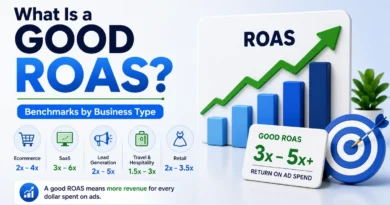
This depends heavily on the industry and profit margins. A business with high margins might be profitable at 2x ROAS, while a low margin business might need 5x or higher just to break even.
What is considered a good ROI?
Anything above 0% means you made a profit, but most businesses aim for a healthy margin well above break even, often 20% or more, depending on the industry and risk involved.
Can ROAS be high while ROI is negative?
Yes. This happens when ad spend is efficient but total business costs, like product cost or operations, are too high compared to revenue.
Conclusion
ROAS shows how efficiently your ad spend is generating revenue, while ROI shows whether your business is actually making money once every cost is included. Neither metric replaces the other. Use ROAS to fine tune ad campaigns and use ROI to judge the true profitability of your business or marketing effort. Tracking both gives a complete and honest view of performance.