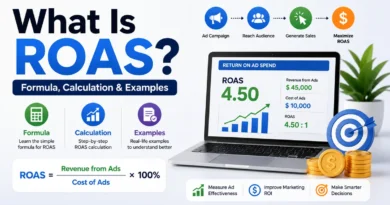
How to Calculate ROAS: Simple Formula & Examples
Knowing your ROAS is one of the fastest ways to check if your ad spend is actually working. The good news is that the calculation itself is simple, you just need the right numbers and a clear process. This article walks through the formula, a step by step method to calculate it, and multiple real examples so you can apply it directly to your own campaigns.
What Is ROAS?
ROAS stands for Return on Ad Spend. It shows how much revenue you earned for every rupee spent on advertising. It does not include product cost or other business expenses, it only compares ad spend against ad generated revenue.
The Simple ROAS Formula
ROAS = Revenue from Ads / Ad Spend
That is the entire formula. You take the total revenue your ads generated and divide it by how much you spent to generate that revenue. The result tells you how many rupees came back for every rupee spent.
How to Calculate ROAS: Step by Step
Step 1: Gather Your Ad Spend Data
Pull the total amount spent on the campaign, ad set, or ad you want to measure. This should include the full budget spent during the time period you are analyzing, whether that is a day, a week, or the full campaign duration.
Step 2: Gather Your Revenue Data
Find the total revenue directly attributed to that ad. Most ad platforms, like Google Ads, Meta Ads Manager, or Amazon Advertising, track this automatically through conversion tracking or pixel data. Make sure the revenue figure only reflects sales tied to that specific campaign, not your entire store’s revenue for the day.
Step 3: Divide Revenue by Ad Spend
Apply the formula:
ROAS = Revenue from Ads / Ad Spend
Step 4: Express the Result
You can show ROAS as a ratio, like 4x, or as a percentage, like 400%. Both mean the same thing, so use whichever format your team prefers for reporting.
Simple ROAS Calculation Example
Say you run a single ad campaign for one week.
- Ad Spend: ₹6,000
- Revenue from Ads: ₹24,000
ROAS = ₹24,000 / ₹6,000 = 4x
For every rupee you spent, you earned four rupees back in revenue.
Calculating ROAS Across Multiple Campaigns
If you are running several campaigns at once, you can calculate ROAS individually or as a combined average, known as blended ROAS.
Individual Campaign ROAS
Campaign 1: Spend ₹4,000, Revenue ₹16,000 ROAS = ₹16,000 / ₹4,000 = 4x
Campaign 2: Spend ₹6,000, Revenue ₹18,000 ROAS = ₹18,000 / ₹6,000 = 3x
This tells you Campaign 1 is performing more efficiently than Campaign 2, even though Campaign 2 generated more total revenue.
Blended ROAS
Blended ROAS looks at total ad spend and total revenue across all campaigns combined, giving you one overall number.
Total Ad Spend = ₹4,000 + ₹6,000 = ₹10,000 Total Revenue = ₹16,000 + ₹18,000 = ₹34,000
Blended ROAS = ₹34,000 / ₹10,000 = 3.4x
Blended ROAS is useful for a quick overall health check, while individual campaign ROAS helps you decide where to shift budget.
Calculating Net ROAS vs Gross ROAS
Standard ROAS only looks at revenue, but some businesses prefer net ROAS, which factors in returns and discounts to get a more accurate picture.
Gross ROAS uses total revenue before any refunds.
Net ROAS uses revenue after subtracting refunds and returns.
Example
- Ad Spend: ₹10,000
- Gross Revenue from Ads: ₹40,000
- Refunds: ₹5,000
Gross ROAS = ₹40,000 / ₹10,000 = 4x
Net ROAS = (₹40,000 − ₹5,000) / ₹10,000 = ₹35,000 / ₹10,000 = 3.5x
Net ROAS gives a more honest number, especially for businesses with a high return rate.
How to Calculate Your Break Even ROAS
Before you can judge whether your ROAS is good, you need to know the minimum ROAS required to avoid a loss. This is called break even ROAS, and it is based on your profit margin.
Break Even ROAS = 1 / Profit Margin
Example
If your profit margin is 20%, or 0.20:
Break Even ROAS = 1 / 0.20 = 5x
This means you need at least a 5x ROAS just to cover your costs. Anything above that is real profit, anything below it means you are losing money despite having sales.
Quick Reference: ROAS Calculation Formulas
| What You Want to Calculate | Formula |
|---|---|
| Basic ROAS | Revenue from Ads / Ad Spend |
| Blended ROAS | Total Revenue (all campaigns) / Total Ad Spend (all campaigns) |
| Net ROAS | (Revenue − Refunds) / Ad Spend |
| Break Even ROAS | 1 / Profit Margin |
Common Mistakes When Calculating ROAS
Using the wrong time period. Make sure ad spend and revenue figures cover the exact same date range, or the number will be misleading.
Mixing up attributed revenue with total store revenue. Only include sales that came directly from that specific ad or campaign.
Forgetting refunds and returns. Skipping this step can make your ROAS look better than it actually is.
Not calculating break even ROAS first. Without knowing your break even point, a 3x or 4x ROAS means very little on its own.
Final Takeaway
Calculating ROAS is straightforward once you have accurate ad spend and revenue numbers. Use the basic formula, Revenue from Ads divided by Ad Spend, for quick checks, but go a step further with blended ROAS, net ROAS, and break even ROAS for a more complete and honest view of your ad performance. Once you know your break even number, every ROAS calculation after that becomes far more meaningful.