Link Building in SEO: Strategies That Work
Link buildingis the process of earning links from other websites to pages on a site. Search engines treat these links as signals of trust, so pages with relevant, editorial backlinks usually have a better chance to rank.
The strategies that work are creating content worth citing, targeted outreach, and digital PR. Bought links and bulk directory links do not work.
What Is Link Building in SEO?
A backlink is a link from one website that points to a page on another website. Link building is the work of getting those links, either by earning them with useful content or by asking for them where a page genuinely adds value.
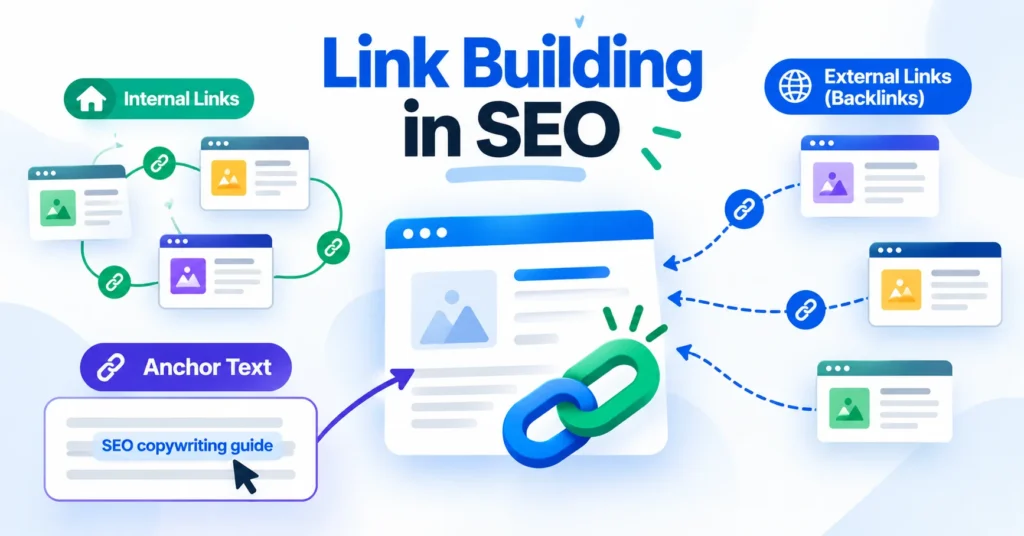
Three terms come up in almost every link building discussion:
- Internal links connect pages inside the same site.
- External links (backlinks) come from other sites and act as independent endorsements.
- Anchor text is the clickable text of a link. Keyword research must be as require anchor text, Descriptive anchors such as “SEO copywriting guide” help search engines understand the target page better than “click here”.
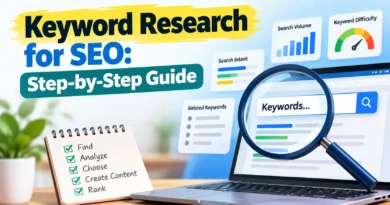
Note: Keyword research can help identify relevant anchor text, but anchor text should always sound natural. Avoid forcing exact-match keywords into every link.
Yoast makes a useful point here. Search engines use links like roads to find new pages, so a page with no inbound links can be hard to discover at all.
Why Link Building Still Matters
Backlinks remain one of the main ranking signals Google uses. Search Engine Journal describes good links as votes that show how worthwhile a page is. Link building also does more than lift rankings:
- Discovery: crawlers find and index new pages by following links.
- Trust: links from respected sites show that others stand behind the content.
- Referral traffic: a link in a relevant article sends real visitors.
- AI visibility: a Semrush study done with Kevin Indig found that backlink factors such as link quality influence how often brands appear in AI answers.
Brand mentions without a link also count. Both Semrush and Yoast point out that mentions, structured data, and author profiles now work alongside backlinks as trust signals.
What Makes a Backlink Worth Pursuing
Not every link carries the same weight. Some have no effect, and spammy ones can cause harm.
Authority
Links from sites with a broad base of referring sites, steady organic traffic, and a clear topical focus usually pass more value. Google has not published an official authority score, so metrics like Semrush’s Authority Score are only proxies.
Relevance
A link to an online word counter from a writing tips blog is worth more than the same link from an unrelated gardening forum. Relevance applies to the site, the page, and the paragraph around the link.
Placement
Google’s reasonable surfer patent (US8117209B1) describes giving more weight to links people are more likely to click. Semrush notes that nobody can confirm Google uses it, but the logic is sensible. A link in the main body content generally beats one in a footer or sidebar.
Anchor text
Natural, descriptive anchors help. Over optimized anchors, such as the same exact match phrase repeated across many sites, look manipulative and can lead to a penalty.
Link attributes
Google treats these attributes as hints, so ranking systems may still consider them.
| Attribute | Used for | Typical effect |
|---|---|---|
| No attribute (dofollow) | Normal editorial links | Passes ranking signals |
| rel=”nofollow” | Links the publisher does not endorse | Treated as a hint |
| rel=”sponsored” | Paid or advertising links | Treated as a hint |
| rel=”ugc” | Comments and forum posts | Treated as a hint |
The Semrush and Kevin Indig study also found that nofollow links had almost the same effect on AI visibility as follow links. Context and placement seem to matter more than the attribute alone.
Four Ways to Get Links
| Method | What it involves | Verdict |
|---|---|---|
| Earn | Publishing original content others cite unprompted | Best long term approach |
| Ask | Contacting sites that mention the brand or fit the topic | Works when the page adds real value |
| Add | Listing in directories or creating social profiles | Fine for new sites, weak as a strategy |
| Buy | Paying a site to place a link | Violates Google’s spam policies |
Hiring an agency to run outreach is different from paying a site for a link. The first is a service. The second is a policy violation.
Link Building Strategies That Work
Semrush splits tactics into two groups. Link producers are easier and can bring volume. Association producers take more effort but earn links from higher authority sites and build stronger brand context.
| Strategy | Effort | Speed | Authority potential | Best fit |
|---|---|---|---|---|
| Linkable assets | High | Slow | High | Sites with tools, data, or deep guides |
| Digital PR | High | Medium | Very high | Brands with news or original research |
| Resource page outreach | Medium | Medium | Medium | Niche guides and tools |
| Broken link building | Medium | Medium | Medium | Sites with a good replacement page |
| Link reclamation | Low | Fast | Medium | Sites that already have links |
| Competitor link gap | Medium | Medium | Medium | Finding prospects quickly |
| Guest posting | Medium | Medium | Medium to high | Subject experts |
| Becoming a source | High | Slow | High | Founders and specialists |
| Partner links | Low | Fast | Low | Brands with existing partners |
1. Create Linkable Assets
A linkable asset is a page that attracts links on its own, such as a free tool, a data study, or a deep guide. Semrush cites the compound interest calculator on thecalculatorsite.com as an example. The page combines a calculator, a full guide, and visuals, and it has earned about 3,300 backlinks from about 1,100 referring domains.
The math is simple: 3,300 backlinks divided by 1,100 domains is about 3 backlinks per domain. That is why referring domains are a better measure of reach than raw backlink counts. Search Engine Journal also lists free tools as a proven link earning tactic.
2. Run Digital PR
Digital PR earns coverage on news sites and industry publications through stories with a real hook. Original data works best. Semrush points to Writerbuddy’s analysis of the 50 most visited AI tools, which brought links from Forbes and CNBC. Coverage like this builds links and brand association together.
3. Get Listed on Resource Pages
Resource pages curate useful links in one niche. Search operators find them quickly:
[topic] inurl:resources[topic] "helpful resources"[topic] "useful links"
Prefer pages that are actively maintained. The outreach message should state what the resource is, why it fits the audience, and where on the page it belongs.
4. Do Broken Link Building
Find dead pages that other sites still link to, then suggest a working replacement. Site owners want to fix broken links, so the request helps them too. A backlink tool’s broken pages report, sorted by referring domains, shows the best candidates first.
5. Reclaim Lost Links and Unlinked Mentions
Recovering a lost link is often easier than winning a new one. A links audit shows which referring domains were lost in the last 30, 60, or 90 days. Semrush suggests starting with lost links from domains with an Authority Score above 40. Unlinked brand mentions are a second easy source, because the site already knows the brand.
6. Study Competitor Backlinks
A backlink gap report lists domains that link to several competitors but not to the target site. Those domains are proven prospects. The aim is to find similar opportunities, not to copy each link, since many placements depend on relationships a different site does not have.
7. Write Guest Posts Carefully
Guest posting can earn a link and put a brand in front of a relevant audience. Searching for a competitor’s name with “contributor” or “guest post” shows where they publish. Pitch a related but different angle, because editors rarely run a second piece on the same topic.
8. Become a Source
Journalists look for expert comments through platforms like Featured and HARO, and through the #JournoRequest hashtag on X. A quote can earn a link or at least a brand mention. The tactic is competitive and needs consistent effort.
9. Ask Partners for Links
Technology partners, resellers, and industry bodies often have partner pages. These links pass little authority, but they show search systems which category a brand belongs to.
Link Building Tactics to Avoid
Shortcuts still exist, and they still cause damage:
- Buying links or paying sites for placements
- Private blog networks (PBNs) and link farms
- Comment, forum, and profile spam
- Repeating the same exact match anchor across many sites
- Mass directory submissions with no quality check
Yoast cites an Editorial.link survey in which PBNs ranked among the most effective of the risky tactics. Even so, they break Google’s spam policies, and recovery from a penalty can take months. A short term gain is not worth that cost.
How to Build Links Step by Step
- Fix the basics first. Confirm pages are crawlable, indexed, and listed in the sitemap. Links to a page that cannot be indexed are wasted.
- Audit the current backlink profile. Note referring domains, top linked pages, lost links, and any toxic backlinks.
- Pick target pages. Choose pages that deserve links, such as tools, original data, or in depth guides.
- Build a prospect list. Use competitor gap reports, resource page searches, and broken link reports. Record the site, the contact, and the reason it fits.
- Send specific outreach. Reference one real detail of the prospect’s content, explain the benefit to its readers, and name the exact page and placement.
- Follow up once and say thanks. One polite follow up is enough. Thank every site that links.
- Track and repeat. Review new and lost links monthly and drop tactics that bring nothing.
How to Track Link Building Results
Useful signals include:
- Referring domains gained and lost each month
- Authority metric trend from a backlink tool
- Referral traffic from linked pages in analytics
- Ranking and impressions for the pages that received links
- Google Search Console Links report for a free view of top linking sites and top linked pages
Progress is gradual. Expect weeks to months before ranking changes appear.
Link Building FAQ
What is meant by link building?
Link building is the process of getting other websites to link to a page on a site. Search engines use these links as signals of trust and relevance. The aim is higher rankings, referral traffic, and stronger brand visibility.
Does link building still work?
Yes, when the links are relevant and earned. Google still uses backlinks as a ranking signal, but quality matters far more than quantity. Old tactics such as PBNs and comment spam no longer work reliably.
What is white label link building?
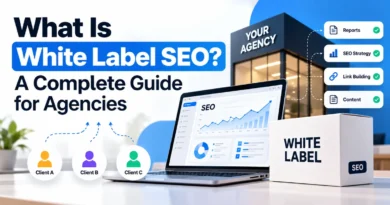
White label link building means an agency hires a provider to run link outreach and then delivers the results to clients under the agency’s own brand. It is allowed as a service, but the links must be earned on real, relevant sites. Paying websites directly for links is still against Google’s spam policies.
How many backlinks are needed to rank?
There is no fixed number. The target depends on the competing pages, so the practical method is to compare the referring domains of the top-ranking pages for the keyword. Ten relevant links can beat a hundred weak ones.
Are nofollow links useful?
Yes. Google treats nofollow as a hint, not a strict block. The Semrush and Kevin Indig study also found nofollow links had almost the same effect on AI visibility as follow links.