
Vitamin B12 Deficiency: Symptoms, Causes & Treatment
Vitamin B12 deficiency happens when the body does not get enough B12 from food or cannot absorb what it gets. It commonly causes tiredness, pale skin, tingling in the hands and feet, memory problems and low mood. It is treated with B12 tablets, injections, nasal spray or a change in diet, depending on the cause. Most cases respond well, but nerve damage from a long delay can become permanent.
Quick facts
- Adults need about 2.4 micrograms (mcg) of B12 a day.
- The body stores B12 in the liver, so symptoms can take years to appear.
- Deficiency is common in people who eat no animal products, adults above 75, and people on certain long term medicines.
- A simple blood test confirms it.
What Is Vitamin B12 and Why Does the Body Need It?
Vitamin B12, also called cobalamin, is a water soluble vitamin that helps make red blood cells and DNA and keeps nerve cells healthy. The body cannot produce it. It has to come from animal foods such as meat, fish, eggs and dairy, or from fortified foods and supplements.
How the body absorbs B12
Absorption takes two steps. Stomach acid first releases B12 from the food protein it is attached to. The released B12 then binds to intrinsic factor, a protein made in the stomach, and is absorbed in the small intestine. A fault at either step can cause deficiency even when the diet is adequate.
How much B12 is needed each day
| Age or life stage | Recommended daily amount (mcg) |
|---|---|
| Infants 0 to 6 months | 0.4 |
| Infants 7 to 12 months | 0.5 |
| Children 1 to 3 years | 0.9 |
| Children 4 to 8 years | 1.2 |
| Children 9 to 13 years | 1.8 |
| Teens and adults 14 years and above | 2.4 |
| Pregnancy | 2.6 |
| Breastfeeding | 2.8 |
Source:US National Institutes of Health, Office of Dietary Supplements.
You may like to read: Vitamin B12 Foods for Vegetarians
Vitamin B12 Deficiency Symptoms
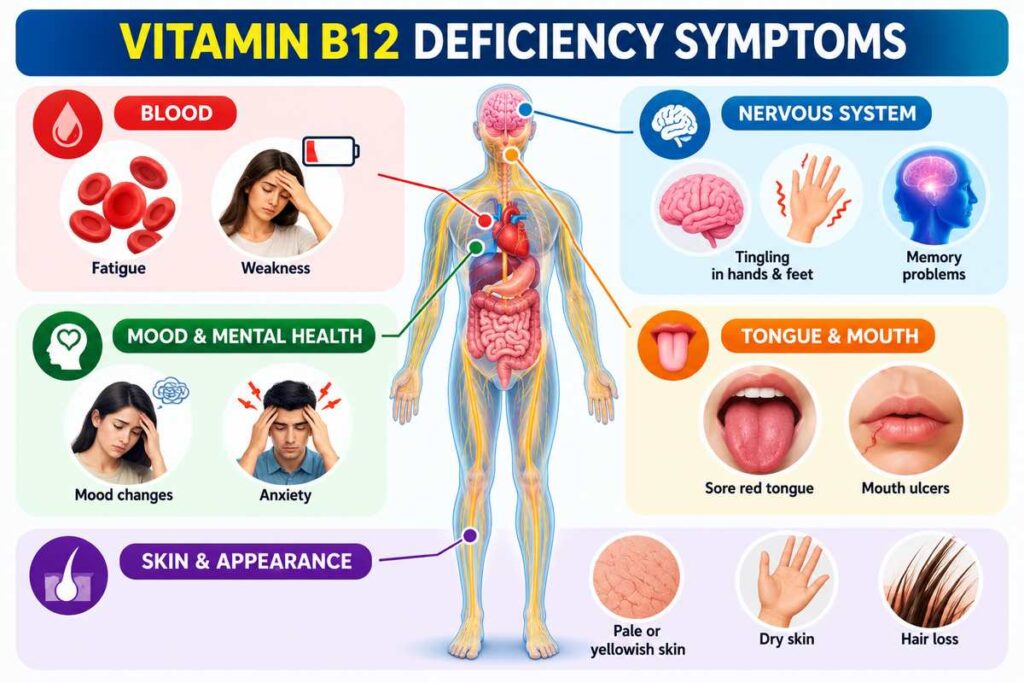
Symptoms usually build up slowly and worsen over time. Some people have a low B12 level and no symptoms at all. When symptoms do appear, they fall into three groups.
Physical symptoms
- Constant tiredness or weakness
- Pale or slightly yellow skin
- Shortness of breath, light headedness or heart palpitations
- A sore, smooth, red tongue (glossitis) or mouth ulcers
- Nausea, diarrhea or loss of appetite
- Weight loss
- Bluish or gray brown nails
Neurological symptoms
- Numbness or tingling in the hands and feet
- Trouble walking or balancing
- Difficulty remembering things or thinking clearly
- Vision problems. Damage to the optic nerve is rare and was reported in fewer than 1% of people with deficiency, according to WebMD’s review of the research.
Psychological symptoms
- Low mood or depression
- Irritability
- Changes in behavior or personality
Tiredness and pale skin also appear in iron deficiency, so a blood test is needed to tell the two apart. In practice, early B12 symptoms are often put down to stress, age or poor sleep, which is why deficiency is frequently found late.
Why symptoms appear late: a simple calculation
The body holds roughly 1,000 to 2,000 times the amount of B12 eaten in a single day (WebMD). With the recommended 2.4 mcg a day, that is a store of about 2.4 to 4.8 mg. A person who stops absorbing B12 completely can therefore feel fine for a long time. The liver can keep enough in reserve for up to five years. By the time symptoms show, the stores are usually close to empty.
The four stages of B12 deficiency
| Stage | What happens | Symptoms |
|---|---|---|
| Stage 1 | Blood B12 level falls | Usually none |
| Stage 2 | Cell stores of B12 fall | Usually none |
| Stage 3 | Homocysteine and methylmalonic acid rise, DNA production drops | Confusion, mood changes, walking or speech problems, irritability |
| Stage 4 | Macrocytic anemia (very large, poorly functioning red blood cells) | Tiredness, weakness and the Stage 3 symptoms |
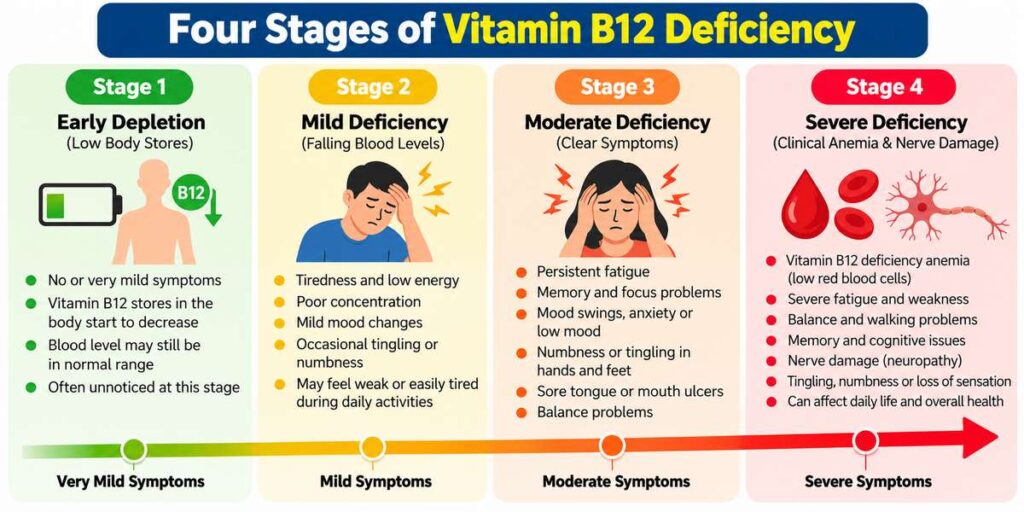
Source: staging described by WebMD, based on published research in the American Journal of Clinical Nutrition.
Causes of Vitamin B12 Deficiency
B12 levels fall for one of three reasons: too little in the diet, poor absorption, or medicine side effects.
| Cause | How it lowers B12 |
|---|---|
| Vegan or vegetarian diet without supplements | B12 occurs naturally only in animal foods |
| Pernicious anemia | The stomach does not make intrinsic factor, so B12 cannot be absorbed |
| Gastritis, including atrophic gastritis | Low stomach acid means B12 is not released from food |
| Crohn’s disease and celiac disease | The damaged intestine absorbs less B12 |
| Stomach or bowel surgery, such as gastric bypass | Less stomach acid, less intrinsic factor, or less absorbing surface |
| Long term heavy alcohol use | Damages the digestive system and reduces absorption |
| Metformin, proton pump inhibitors, H2 blockers, birth control pills | Interfere with absorption |
| Rare genetic disorders such as transcobalamin II deficiency | B12 cannot circulate properly in the body |
Who is at higher risk
- Adults above 75 years
- People who follow a vegan diet, or a vegetarian diet low in eggs and dairy
- People with digestive or autoimmune conditions, including Sjögren’s syndrome
- People who take metformin or acid reducing medicines for years
- People who drink heavily
- Breastfed babies of mothers who eat no animal products and take no B12
For a planned vegetarian diet, B12 needs a deliberate source because plant foods do not provide it naturally. Anyone who follows daily nutrient targets for other nutrients should add B12 to that list.
Complications of Untreated B12 Deficiency
Untreated deficiency can damage the nervous system and brain. Reported complications include:
- Peripheral neuropathy (nerve damage in the limbs)
- Degeneration of the spinal cord
- Difficulty walking, and in severe cases paralysis
- Bladder or bowel control problems
- Memory loss, paranoia and delusions
- Erectile dysfunction
Anemia from B12 deficiency is reversible with treatment. Nerve damage may not be, which is the main reason early testing matters. During pregnancy, severe deficiency can affect the baby’s growth and brain and spinal development.
How Vitamin B12 Deficiency Is Diagnosed
Diagnosis can be difficult because symptoms overlap with other nutritional gaps such as vitamin D deficiency. Doctors rely on blood tests, particularly for people at higher risk.
- Complete blood count (CBC): checks for anemia and unusually large red blood cells.
- Serum vitamin B12 test: measures B12 in the blood.
- Methylmalonic acid (MMA) test: rises when cells are short of B12.
- Homocysteine test: also rises when B12 is low.
A borderline B12 result with a high MMA or homocysteine usually points to a real deficiency at cell level.
Vitamin B12 Deficiency Treatment
Treatment depends on the cause. The aim is to bring levels back to normal and fix the reason they fell. Doctors may prescribe cyanocobalamin, a manufactured form of B12.
| Method | Best suited for | Key points |
|---|---|---|
| B12 injections | Severe deficiency, anemia, pernicious anemia, absorption problems | Given into a muscle. More frequent at first, then spaced out. Some people need them every two to three months for life |
| Oral tablets | Mild to moderate deficiency, dietary shortfall | Doses of 500 or 1,000 mcg are common. The body absorbs only what it needs |
| Nasal spray or gel | People who cannot take tablets or injections | Alternative route, prescribed by a doctor |
| B12 rich foods | Mild deficiency and prevention | Meat, fish, eggs, dairy and fortified foods |
Supplements do not need stomach acid, but they still need intrinsic factor. When intrinsic factor is missing, as in pernicious anemia, tablets may not work well and injections are used.
Food sources of B12
Beef liver is the richest common source, with 70.7 mcg in a 3 ounce cooked serving. That is about 29 times the daily requirement for an adult.
Cooked clams give 17 mcg per 3 ounces. Other sources include salmon, tuna, ground beef, eggs, milk, curd, cheese and fortified cereals, breads, plant milks and nutritional yeast.
How long does treatment last?
Some people need B12 only until levels normalize. Others, such as those with pernicious anemia or after stomach surgery, need it for life. Mild deficiency often improves quickly. Nerve damage that has been present for a long time may only partly recover.
How to Prevent Vitamin B12 Deficiency
- Include animal foods or B12 fortified foods daily.
- Take a B12 supplement on a vegan diet.
- Check B12 levels periodically after age 50 or when taking metformin or acid reducing medicine long term.
- Limit alcohol.
- Keep digestive conditions under medical follow up.
- Tell the doctor about any B12 supplement in use, so the dose fits other medicines.
When to Get Tested
- Notice persistent tiredness, tingling, balance problems or memory changes.
- Check for risk factors such as vegan diet, age above 75, metformin or acid reducing medicine, or digestive disease.
- Ask a doctor for a CBC and a B12 test, with MMA or homocysteine if the result is borderline.
- Follow the treatment plan and repeat the blood test as advised.
- Seek urgent care for new weakness, trouble walking, loss of vision or confusion.
FAQs About Vitamin B12 Deficiency
What are the first signs of vitamin B12 deficiency?
Early signs are usually tiredness, weakness, pale skin and a sore tongue. Tingling in the hands or feet and trouble concentrating can follow. Some people have no symptoms at first.
Can vitamin B12 deficiency be cured?
Yes, in most cases. Supplements, injections or diet changes restore normal levels. People with pernicious anemia or after stomach surgery often need lifelong treatment to keep levels normal.
Which food has the most vitamin B12?
Beef liver has the most, at 70.7 mcg per 3 ounce cooked serving. Clams come next at 17 mcg for the same serving size. Fish, eggs, dairy and fortified foods also contribute.
Can vegetarians get enough B12 from food?
Vegetarians who eat eggs and dairy regularly can get some. Vegans cannot rely on natural food sources and need fortified foods or a supplement.
Is too much vitamin B12 harmful?
No upper limit has been set for B12, and one study found no side effects at doses as high as 2,000 mcg. Rare reports of acne or palpitations exist, mostly with injections. Supplement doses are best set by a doctor.
How is B12 deficiency different from anemia?
Anemia means too few healthy red blood cells, and B12 deficiency is one possible cause. B12 deficiency can also exist without anemia and still affect nerves and mood.
Sources: US National Institutes of Health, Office of Dietary Supplements (Vitamin B12 fact sheet); Cleveland Clinic (Vitamin B12 Deficiency, reviewed Sept 2025); WebMD (reviewed April 2025); Ankar A, Kumar A, StatPearls; Langan RC, Goodbred AJ, American Family Physician, 2017. This article is for information and does not replace medical advice.