
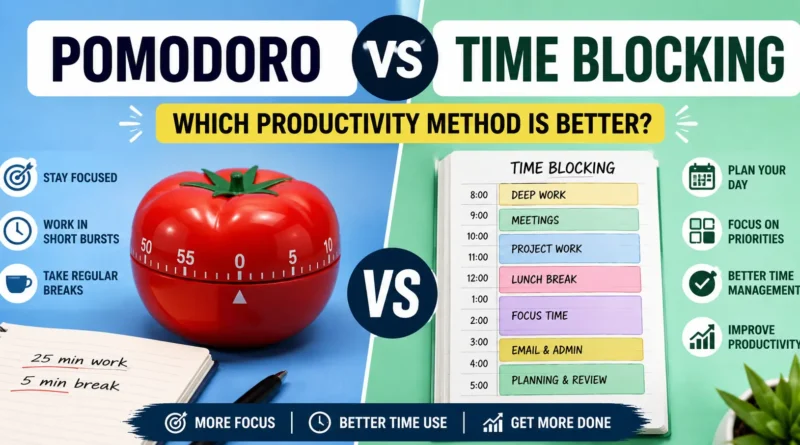
Pomodoro vs Time Blocking: Which Productivity Method Is Better
Choosing the right productivity system can feel overwhelming when there are so many options. Two of the most popular methods are the Pomodoro Technique and time blocking. Both promise better focus and fewer wasted hours, but they work in very different ways.
This article breaks down how each method works, their strengths and weaknesses, and how to decide which one fits your work style.
What Is the Pomodoro Technique
The Pomodoro Technique is a time management strategybuilt around short, focused work sessions. You work for 25 minutes, then take a 5-minute break. After four sessions, you take a longer break of 15 to 30 minutes.
The method relies on a visible timer to create urgency and reduce distractions. It is designed for people who need help staying focused on a single task without drifting into multitasking.
You may like: Improve Focus Using the Pomodoro Technique
What Is Time Blocking
Time blocking is a scheduling method where you divide your entire day into blocks of time, each assigned to a specific task or activity. Instead of working from a to do list, you plan exactly when each task will happen on your calendar.
For example, a time blocked day might set 9 to 10 for emails, 10 to 12 for deep work on a project, and 1 to 2 for meetings. Every hour has a purpose, and the goal is to reduce the mental effort spent deciding what to do next.
Key Differences Between Pomodoro and Time Blocking
Both methods aim to improve productivity, but they solve different problems.
Structure. Pomodoro breaks work into short, repeating cycles of focus and rest. Time blocking maps out the full day in advance, with blocks that can range from 15 minutes to several hours.
Flexibility. Pomodoro is easy to start at any moment since it only requires a timer and one task. Time blocking needs planning ahead, usually the night before or first thing in the morning.
Best use case. Pomodoro works well for tasks that require intense focus in short bursts, such as writing, coding, or studying. Time blocking works well for people juggling many different responsibilities across a day, such as managers or business owners.
Break frequency. Pomodoro enforces frequent breaks every 25 minutes. Time blocking leaves breaks up to the individual, which can lead to longer stretches without rest if not planned carefully.
Mental load. Pomodoro reduces the pressure of long work sessions but does not organize your whole day. Time blocking removes the guesswork of what to do next but requires more upfront planning effort.
Benefits of the Pomodoro Technique
The Pomodoro Technique offers a few clear advantages for people who struggle with focus.
It lowers the barrier to starting a task, since committing to 25 minutes feels far less intimidating than committing to hours of work. It also builds in recovery time automatically, which helps prevent burnout during long work days. Many people find it especially useful for tasks they tend to procrastinate on, since the short timer makes starting easier.
Benefits of Time Blocking
Time blocking shines when someone has many competing priorities in a single day.
It gives a complete picture of how time is spent, which helps identify wasted hours or overcommitted schedules. It also protects time for deep work by treating focus sessions as fixed appointments rather than something that gets pushed aside for meetings or emails. People managing teams, running businesses, or balancing multiple projects often find this level of structure valuable.
Drawbacks to Consider
Neither method is perfect for every situation.
Pomodoro can feel disruptive for tasks that require long, uninterrupted focus, such as deep creative work or complex problem solving. Stopping every 25 minutes can break concentration right when momentum builds.
Time blocking can fall apart quickly if the day does not go as planned. Unexpected meetings, interruptions, or tasks taking longer than expected can throw off the entire schedule, leading to frustration.
Can You Use Both Together
Many productive people combine both methods instead of choosing one. A common approach is to use time blocking to plan the day at a high level, assigning specific hours to specific projects or responsibilities. Within each time block, the Pomodoro Technique is then used to structure the actual work into focused sessions with regular breaks.
For example, a 2 hour time block for writing could be broken into four pomodoros of 25 minutes each, with short breaks in between. This combination gives you the big picture structure of time blocking along with the focus and recovery benefits of Pomodoro.
How to Choose the Right Method for You
The best method depends on your role, work style, and the type of tasks you handle most often.
If your day involves many different responsibilities, frequent meetings, or shifting priorities, time blocking will likely help more by giving your day clear structure. If your main challenge is staying focused on a single task without getting distracted, the Pomodoro Technique is probably the better starting point.
Trying both for a week each is a simple way to see which one fits naturally into your routine.
Frequently Asked Questions
Which is better for deep work, Pomodoro or time blocking?
Time blocking is generally better for deep work since it protects longer, uninterrupted periods. Pomodoro can still work if you use longer intervals, such as 50 minutes, instead of the standard 25.
Can I use Pomodoro inside a time blocking schedule?
Yes. Many people schedule time blocks for specific tasks and then use Pomodoro sessions within those blocks to stay focused.
Which method is easier for beginners?
Pomodoro is usually easier to start since it only requires a timer and one task. Time blocking takes more planning but offers greater long term organization.
Does time blocking work for people with unpredictable schedules?
It can be harder to maintain with unpredictable schedules, but building in buffer blocks for unexpected tasks can help make it more flexible.
Is one method scientifically proven to be better than the other?
Neither method has strong scientific consensus proving it is universally better. Both are based on established productivity principles like focused work and structured breaks, and effectiveness often depends on personal work style.
Final Thoughts
Pomodoro and time blocking both offer real benefits, but they solve different challenges. Pomodoro helps you focus in the moment, while time blocking helps you organize your entire day. Instead of picking one over the other permanently, consider testing both, or combining them, to build a productivity system that fits how you actually work.