
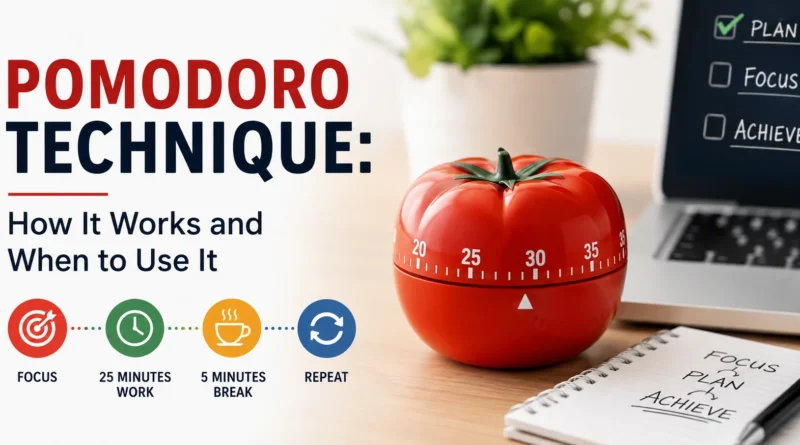
Pomodoro Technique: How It Works and When to Use It
Staying focused for long hours is hard. The mind wanders, notifications pop up, and before you know it, an hour has passed with nothing done. This is where the Pomodoro Technique comes in. It is one of the most trusted time management methods used by students, professionals, and creators around the world to boost focus and get more done in less time.
In this article, you will learn what the Pomodoro Technique is, how it works, its benefits, and when you should use it.
What Is the Pomodoro Technique
The Pomodoro Technique is a time management method developed by Francesco Cirillo in the late 1980s. The name comes from the Italian word for tomato, inspired by the tomato shaped kitchen timer Cirillo used as a university student.
The core idea is simple. You break your work into short, focused intervals called pomodoros, usually 25 minutes long, followed by a short break. After completing four pomodoros, you take a longer break. This cycle trains your brain to focus in short bursts instead of forcing long, exhausting sessions of work.
The technique is built on a simple truth. The human brain cannot maintain deep focus for hours without rest. Short, timed intervals with planned breaks help maintain mental clarity, reduce burnout, and improve overall productivity.
How the Pomodoro Technique Works
The process is easy to follow and does not require any special tools, though many people now use apps or online timers.
Here is the standard structure:
- Choose a task you want to work on.
- Set a timer for 25 minutes. This is one pomodoro.
- Work on the task with full focus until the timer rings.
- Take a short break of 5 minutes.
- Repeat the cycle. After completing four pomodoros, take a longer break of 15 to 30 minutes.
This simple loop of work and rest keeps your brain fresh and prevents fatigue. The timer creates urgency, which naturally reduces procrastination and distractions.
Example of a Pomodoro Session
Suppose you need to write a report. Here is how a real session might look:
| Step | Activity | Duration |
|---|---|---|
| 1 | Write the introduction section | 25 minutes |
| 2 | Short break, stretch or walk | 5 minutes |
| 3 | Write the main body content | 25 minutes |
| 4 | Short break, drink water | 5 minutes |
| 5 | Edit and review the draft | 25 minutes |
| 6 | Short break | 5 minutes |
| 7 | Finalize and proofread | 25 minutes |
| 8 | Long break | 15 to 30 minutes |
By the end of this cycle, the report is complete, and the mind has had regular recovery time throughout the process. This example shows how breaking large tasks into small, timed chunks makes big projects feel manageable.
Why the Pomodoro Technique Works
The effectiveness of this method comes from a mix of psychology and simple structure. Here is why it works so well for so many people.
- Reduces mental fatigue. Short work intervals prevent the brain from getting overwhelmed.
- Improves focus. Knowing you only need to concentrate for 25 minutes makes starting a task feel easier.
- Fights procrastination. The ticking timer creates gentle pressure to begin working immediately.
- Builds momentum. Completing one pomodoro often motivates you to complete another.
- Encourages regular breaks. Breaks are proven to restore attention and prevent burnout.
- Helps track productivity. Counting completed pomodoros gives a clear measure of how much focused work was done.
Popular comparison:
- Pomodoro vs Time Blocking
- Pomodoro vs Flowtime Technique
- Pomodoro vs Deep Work
- Pomodoro vs Marinara
- Pomodoro vs Alfredo
- Pomodoro vs Napolitana
Benefits of Using the Pomodoro Technique
The Pomodoro Technique offers several practical benefits beyond just time management.
Better focus and concentration: Working in short, timed sessions trains the brain to stay present and avoid multitasking, which is one of the biggest productivity killers.
Reduced burnout: Regular breaks prevent the exhaustion that comes from working nonstop for hours.
Improved task estimation: Over time, you start understanding how many pomodoros a task actually needs, which helps with better planning.
Increased accountability: Tracking completed pomodoros gives a visual sense of progress, which keeps motivation high.
Works for almost any task: Whether it is studying, writing, coding, or even household chores, the technique adapts easily to different types of work.
When to Use the Pomodoro Technique
The Pomodoro Technique is not a one-size-fits-all solution, but it works exceptionally well in certain situations.
- Studying for exams, where focused revision sessions with breaks improve memory retention.
- Writing tasks, such as blogs, reports, or content creation, where deep focus is needed.
- Repetitive or boring work, since the timer makes it easier to push through.
- Managing distractions, especially for people who struggle with phone notifications or social media.
- Freelancers and remote workers who need structure without a traditional office environment.
- Team projects, where pomodoro sprints can be used for focused group work sessions.
It may be less useful for tasks requiring deep, uninterrupted creative flow, such as complex problem solving or creative writing that benefits from long stretches of thought. In such cases, longer intervals like 50 or 90 minutes can be tested instead of the standard 25 minute format.
Tips to Use the Pomodoro Technique Effectively
- Turn off notifications during each pomodoro session.
- Keep a physical or digital tracker to log completed pomodoros.
- Avoid checking your phone during breaks if it tends to distract you further.
- Adjust the timer length if 25 minutes feels too short or too long for your work style.
- Plan your task list before starting the first pomodoro session.
Frequently Asked Questions
What is the ideal length for a pomodoro session?
The standard length is 25 minutes of focused work followed by a 5 minute break, but this can be adjusted based on personal preference and task type.
Can the Pomodoro Technique be used for team work?
Yes, many teams use pomodoro sprints during meetings or collaborative work sessions to maintain group focus and structure.
Does the Pomodoro Technique work for creative tasks?
It can, though some creative workers prefer longer, uninterrupted sessions. Testing different interval lengths helps find the right balance.
What tools can help with the Pomodoro Technique?
Simple kitchen timers, smartphone timers, or dedicated productivity apps all work well. The method does not require any special software.
Final Thoughts
The Pomodoro Technique remains popular because it is simple, flexible, and backed by real results. By breaking work into focused intervals with planned breaks, it helps reduce procrastination, improve concentration, and prevent burnout. Whether you are a student, a working professional, or someone managing personal projects, this method offers a practical way to get more done without feeling overwhelmed.
Start with a single pomodoro today, and build the habit one focused session at a time.