
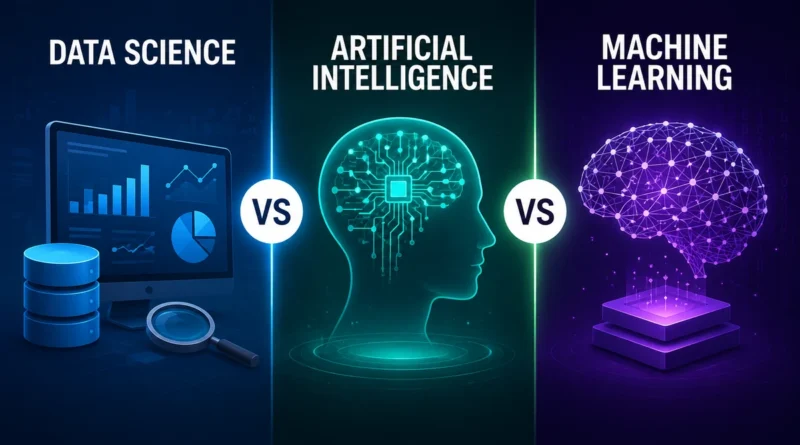
Data Science vs Artificial Intelligence vs Machine Learning: What Is the Real Difference?
Technology terms often get mixed up. People use Data Science, Artificial Intelligence (AI), and Machine Learning (ML) as if they mean the same thing. They do not. Each field has its own goal, its own tools, and its own place in the tech world. This article breaks down each term in simple language, with real examples, so you understand exactly where one ends and the other begins.
What Is Data Science?
Data Science is the field of collecting, cleaning, and studying data to find useful patterns and insights. A data scientist works with numbers, text, images, and other raw information to answer business questions.
Data science is not one skill. It is a mix of statistics, programming, and domain knowledge. A data scientist may use Python, SQL, or Excel to study sales trends, customer behavior, or website traffic.
Example: An e-commerce company wants to know why sales dropped last month. A data scientist studies the sales data, checks seasonal trends, and finds that a shipping delay caused the drop. This is data science in action: turning raw data into a clear answer.
Core Tasks in Data Science
- Data cleaning and preparation
- Statistical analysis
- Data visualization (charts, graphs, dashboards)
- Reporting insights to business teams
What Is Artificial Intelligence?
Artificial Intelligence is a broader concept. It means building machines or software that can perform tasks that normally need human intelligence. This includes thinking, reasoning, understanding language, recognizing images, and making decisions.
AI is the big umbrella. It covers many technologies, and machine learning is one part of that umbrella. AI also includes rule-based systems, robotics, expert systems, and natural language processing.
Example: A voice assistant like Siri or Alexa understands your spoken question and gives an answer. This involves multiple AI technologies working together: speech recognition, language understanding, and response generation.
Core Goals of AI
- Mimic human decision-making
- Automate complex tasks
- Understand and process language, sound, and images
- Improve over time through experience (in many modern systems)
What Is Machine Learning?
Machine Learning is a subset of AI. It is the method that allows a machine to learn from data instead of being told exact rules. Instead of programming every single instruction, developers feed data to an algorithm, and the algorithm learns patterns on its own.
ML is the engine behind most modern AI systems today. Without machine learning, many AI tools like recommendation engines or spam filters would not exist.
Example: Netflix recommendations are a classic ML example. The system studies what you watched before and predicts what you might like next. It gets smarter as it collects more data about your habits.
Types of Machine Learning
- Supervised Learning: The model learns from labeled data (example: predicting house prices using past sales data)
- Unsupervised Learning: The model finds hidden patterns without labels (example: grouping customers by shopping behavior)
- Reinforcement Learning: The model learns by trial and error, getting rewards for good decisions (example: AI playing chess or Go)
Data Science vs AI vs ML: Side-by-Side Comparison
| Feature | Data Science | Artificial Intelligence | Machine Learning |
|---|---|---|---|
| Definition | Study of data to extract insights | Machines that mimic human intelligence | Subset of AI that learns from data |
| Main Goal | Find patterns and support decisions | Automate human-like tasks | Improve accuracy through experience |
| Scope | Broad field using stats and coding | Broadest umbrella term | Narrower, technical method |
| Tools | Python, R, SQL, Tableau | Neural networks, robotics, NLP | TensorFlow, Scikit-learn, PyTorch |
| Output | Reports, dashboards, insights | Smart systems, automation | Trained models, predictions |
| Example | Sales trend report | Self-driving car system | Spam email filter |
How These Three Fields Connect
Think of it like a set of circles. Artificial Intelligence is the largest circle. Inside it sits Machine Learning, a specific way to achieve AI. Data Science overlaps with both, because it supplies the clean, organized data that machine learning models need to learn properly.
A simple flow looks like this:
Raw Data → Data Science (cleaning and analysis) → Machine Learning (pattern learning) → Artificial Intelligence (smart application)
Example in real life: A bank wants to detect fraud.
- Data scientists collect and clean transaction data.
- Machine learning engineers build a model that learns what fraud looks like.
- The final fraud detection system, which flags suspicious transactions instantly, is a working example of AI.
Which Career Should You Choose?
Many students and professionals ask which path to pick. The answer depends on interest and strength.
- Choose Data Science if you enjoy statistics, business problems, and storytelling with numbers.
- Choose Machine Learning if you enjoy building algorithms and improving prediction accuracy.
- Choose AI (broader field) if you want to work on advanced systems like robotics, computer vision, or language models.
All three paths overlap in skills like Python programming, math, and problem solving. A strong foundation in one often opens doors to the other two.
Common Myths Cleared Up
Myth 1: AI and ML are the same thing. False. ML is one method used to build AI. AI also includes other approaches like rule-based logic.
Myth 2: Data Science is just coding. False. Coding is a tool, not the goal. The real goal is finding insights and helping decisions.
Myth 3: You need a PhD to work in these fields. False. Many professionals enter through online courses, bootcamps, and hands-on projects.
Final Thoughts
Data Science, Artificial Intelligence, and Machine Learning are connected but different. Data science focuses on extracting insights from data. AI focuses on building smart systems that act like humans. Machine learning is the technical method that powers most modern AI by learning from data patterns.
Understanding these differences helps you pick the right career path, choose the right tool for a project, and communicate clearly in the tech industry. As these fields keep growing, knowing where one ends and the other begins gives you a real advantage.