Pomodoro vs Alfredo Timer: Understanding the Productivity Differences
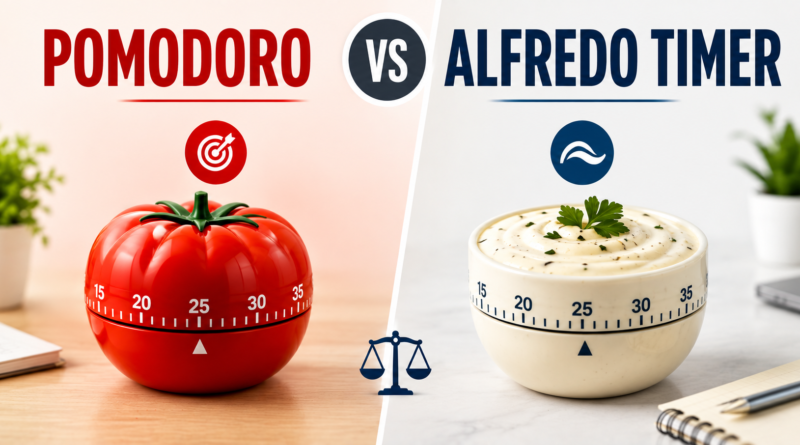
If you have been exploring Pomodoro style timer tools, you may have noticed a growing trend of Italian food names attached to focus apps, including terms like Alfredo Timer. Since Alfredo sauce has a completely different character from a tomato based sauce, it raises a natural question. What does an Alfredo Timer actually offer, and how is it different from the standard Pomodoro Technique?
This article breaks down what each term means, why the naming trend exists, and which approach fits different working styles.
What Is the Pomodoro Technique?
The Pomodoro Technique is a structured time management method created by Francesco Cirillo in the late 1980s. It divides work into short, focused intervals separated by regular breaks, using a simple and repeatable rhythm.
Core structure of the Pomodoro Technique:
- Work in fixed 25 minute intervals
- Take a 5 minute break after each session
- After four completed sessions, take a longer break of 15 to 30 minutes
- Each interval is called a pomodoro, named after the tomato shaped kitchen timer Cirillo originally used
This method is widely recognized and backed by decades of practical use, making it one of the most trusted productivity frameworks available today.
What Is an Alfredo Timer?
Unlike Marinara Timer, which is a genuine, widely used web-based Pomodoro tool, Alfredo Timer is not an official or mainstream productivity application. It falls into the same category as Arrabbiata Timer, a niche or informal naming style that some smaller timer tools use to extend the Italian food theme started by Pomodoro and Marinara.
Alfredo sauce is known for being rich, smooth, and creamy, made with butter, cream, and parmesan rather than tomatoes. Applied to a timer concept, an Alfredo Timer typically implies a slower, smoother, and more relaxed working rhythm compared to the fast, structured bursts of standard Pomodoro sessions.
Typical characteristics associated with an Alfredo style timer:
- Longer work sessions, often 45 minutes or more, without frequent interruptions
- Fewer, longer breaks instead of frequent short ones
- Designed for tasks that benefit from a calm, steady pace rather than urgency
- No official structure or single creator, unlike the Pomodoro Technique
Important distinction: Alfredo Timer is best understood as a concept, not a defined system. It is loosely used to describe a smoother, less rigid alternative to Pomodoro rather than representing one specific, standardized tool.
Pomodoro vs Alfredo Timer: Comparison Table
| Factor | Pomodoro Technique | Alfredo Timer |
|---|---|---|
| Origin | Official method created by Francesco Cirillo | Informal, food themed naming used by some timer tools |
| Standardization | Well defined 25/5 minute structure | Not standardized, varies by app or interpretation |
| Session length | 25 minutes work, 5 minute break | Often longer, 45 minutes or more |
| Pace | Fast, structured bursts | Slow, smooth, relaxed rhythm |
| Recognition | Globally recognized productivity method | Niche term with limited mainstream adoption |
| Best for | Repetitive tasks and building focus habits | Calm, low pressure work that benefits from longer stretches |
Example: Choosing Between the Two Approaches
Example: Consider a graphic designer working on two very different projects in the same week. For quick client revisions and small edits, they use the standard Pomodoro Technique, completing several 25 minute sessions to move through tasks efficiently.
For a larger creative project that requires uninterrupted thinking, such as designing a full brand identity, they switch to a slower, Alfredo style rhythm, working in longer 60 minute stretches with fewer breaks. This mirrors how the creamy, unhurried nature of Alfredo sauce translates into a calmer, less segmented approach to focus.
Which Should You Choose?
Choose the Pomodoro Technique if you:
- Want a proven, well tested time management strategy
- Struggle with procrastination and need frequent restarts
- Work on shorter, repetitive, or administrative tasks
- Prefer clear, consistent timing and structure
Consider an Alfredo style timer if you:
- Need longer, uninterrupted stretches for creative or complex work
- Find frequent 25 minute interruptions disruptive to your concentration
- Are comfortable working without a strict, standardized structure
- Understand this is an informal concept rather than a tested method
If your work often requires sustained concentration rather than short bursts, it is also worth comparing this idea directly with Pomodoro vs Deep Work, since both favor longer, uninterrupted focus over frequent breaks.
Frequently Asked Questions
Is Alfredo Timer an official productivity method?
No. Unlike the Pomodoro Technique, Alfredo Timer is not an official or standardized method. It is an informal, food themed name sometimes used to describe slower, longer paced timer variations.
Is Alfredo Timer the same as Marinara Timer?
No. Marinara Timer is a well established, widely used tool that directly implements the Pomodoro Technique. Alfredo Timer is a much less common, unofficial term without a single defined tool behind it.
How is Alfredo Timer different from Arrabbiata Timer?
Both are informal, food themed variations of Pomodoro, but they represent opposite ideas. Arrabbiata Timer suggests a faster, more intense pace, while Alfredo Timer suggests a slower, smoother, and more relaxed working rhythm.
Should I use an Alfredo style timer for studying?
It depends on the subject. Alfredo style longer sessions can work well for deep reading or complex problem solving, while short Pomodoro Technique focus sessions often work better for memorization or quick revision tasks.
Final Thoughts
The comparison between Pomodoro and Alfredo Timer highlights two very different working rhythms. The Pomodoro Technique offers a proven, structured framework built on short bursts and frequent breaks. Alfredo Timer, as an informal concept, represents the opposite idea, a slower, smoother pace suited to longer, uninterrupted focus.
Neither approach is universally better. The right choice depends on the type of work in front of you, and many people benefit from switching between the two depending on the task at hand.