Pomodoro vs Napolitana Timer: Which Focus Technique Fits Your Workflow?
Choosing the right focus technique can make the difference between a productive day and a scattered one. The Pomodoro Technique is the most widely known time management method, built around short bursts of work and frequent breaks. The Napolitana Timer is a lesser known variation that stretches those intervals into longer, slower sessions, closer to how a Napolitana sauce simmers gently instead of cooking fast.
If you have ever wondered whether short sprints or long simmering sessions suit your brain better, this guide breaks down both methods so you can pick the one that actually fits your workflow.
What Is the Pomodoro Technique?
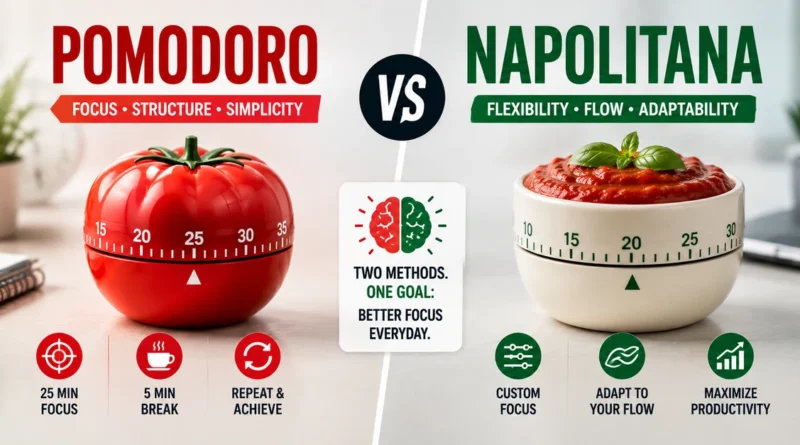
The Pomodoro Technique was developed by Francesco Cirillo in the late 1980s. It uses a timer to break work into fixed intervals, traditionally 25 minutes of focused work followed by a 5 minute break. After four such cycles, you take a longer break of 15 to 30 minutes.
The core idea is simple. Your brain performs better when it works with your natural attention span rather than against it. Short, timed sessions reduce cognitive fatigue, limit task switching, and create a sense of urgency that keeps procrastination in check.
Example: A student revising for an exam sets a 25 minute timer, studies one topic with zero distractions, then takes a 5 minute break to stretch before starting the next Pomodoro. This rhythm is repeated four times before a longer rest.
You may like: Advanced Time Management Tips
What Is the Napolitana Timer?
The Napolitana Timer is a slower, more relaxed cousin of the Pomodoro family of focus timers. Where Pomodoro favors quick, high-intensity sprints, the Napolitana approach stretches the work interval to something closer to 45 to 60 minutes, paired with a longer break of around 15 to 20 minutes.
The name borrows from Napolitana sauce, which simmers slowly to develop deeper flavor, unlike a quick pomodoro sauce. Applied to focus work, this translates into sessions long enough to reach a flow state, the mental zone where distractions fade and deep concentration takes over.
Example: A writer working on a long article sets a 50 minute timer to draft an entire section without interruption, then takes a 15 minute break to walk around before returning for another long session. The extended runway gives enough time to get past the initial warm-up period and into real depth.
Pomodoro vs Napolitana Timer: Key Differences
| Factor | Pomodoro Technique | Napolitana Timer |
|---|---|---|
| Work interval | 25 minutes | 45 to 60 minutes |
| Break length | 5 minutes | 15 to 20 minutes |
| Best for | Repetitive or high-distraction tasks | Deep, complex, or creative tasks |
| Learning curve | Beginner friendly | Requires stronger self-discipline |
| Risk of interruption mid-flow | Higher, since sessions are short | Lower, since sessions run longer |
| Cognitive load | Light bursts | Sustained, deeper concentration |
When to Use the Pomodoro Technique
The Pomodoro Technique works best when your task list is full of small, repetitive, or administrative items. It also suits people who struggle with procrastination or get anxious about long, open-ended work blocks. Because the sessions are short, the barrier to starting is low, and the frequent breaks help maintain energy across a long day.
It is a strong fit for:
- Answering emails or clearing a to-do list
- Studying for exams in multiple subjects
- Tasks that involve frequent context switching
- Beginners who are still building focus discipline
When to Use the Napolitana Timer
The Napolitana Timer suits tasks that need deep work and cannot tolerate constant interruption. Writing, coding, design, strategic planning, and research all benefit from longer, uninterrupted stretches because the first several minutes of any complex task are often spent just getting oriented. A 25 minute Pomodoro can end right as you finally hit your stride, while a Napolitana session gives you room to stay there.
It is a strong fit for:
- Long form writing or content creation
- Software development and debugging
- Strategic planning or financial modeling
- Creative work that depends on sustained momentum
Which One Fits Your Workflow?
There is no universally correct answer here. The right choice depends on your task type, attention span, and how your energy behaves throughout the day.
- If your work is fragmented and interruption-heavy, the Pomodoro Technique keeps you accountable in short, manageable chunks.
- If your work demands sustained focus and creative depth, the Napolitana Timer gives your brain the runway it needs to enter a real flow state.
- Many people actually blend both. Short Pomodoro sprints early in the day for admin work, followed by a longer Napolitana style session in the afternoon for deep, focused tasks.
If neither style feels quite right, it is worth exploring related methods such as the Flowtime Technique, which removes fixed timers entirely and lets you work until natural fatigue sets in, or Time Blocking, which schedules your entire day around dedicated task blocks rather than repeating cycles.
Frequently Asked Questions
Is the Napolitana Timer an official productivity method?
It is not as formally documented as the Pomodoro Technique. It functions more as a community-driven variation, popular among people who find 25 minute sessions too short for deep, complex tasks.
Can beginners start with the Napolitana Timer?
Yes, but it requires more self-discipline since there is a longer stretch before the next break. Beginners often find it easier to start with Pomodoro and gradually extend session length as focus improves.
Which technique is better for remote work?
It depends on the task. Meetings and quick tasks suit Pomodoro, while focused project work benefits from Napolitana style sessions with fewer interruptions.
Do I need a special app for either method?
No. Any basic timer or Pomodoro app can be adapted for Napolitana intervals by simply adjusting the work and break duration settings.
Final Thoughts
Both the Pomodoro Technique and the Napolitana Timer aim to solve the same problem, keeping your focus intact in a world full of distractions. Pomodoro leans on speed and structure, while Napolitana leans on depth and patience. Test both across a normal work week, track how you feel afterward, and let your own energy patterns decide which one earns a permanent spot in your daily routine.