Pomodoro vs Deep Work: Which Productivity Method Should You Choose?
Choosing the right productivity system can change how much you actually get done in a day. Two of the most popular methods, the Pomodoro Technique and Deep Work, take very different approaches to focus. One breaks your day into short timed sprints. The other asks you to protect long, distraction free blocks for your hardest thinking.
This guide compares both methods in detail, explains who each one suits best, and helps you decide which approach fits your work style, energy levels, and daily schedule. If your work is driven by a fixed daily schedule rather than task type, you may also want to compare Pomodoro vs Time Blocking.
What Is the Pomodoro Technique?
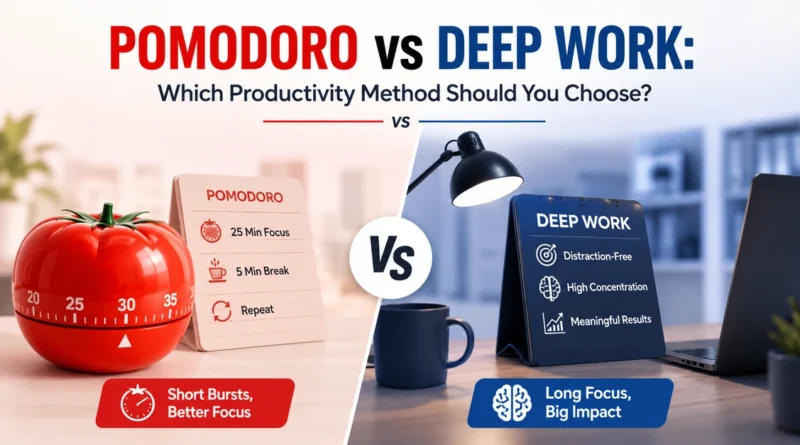
The Pomodoro Technique is a time management strategy created by Francesco Cirillo in the late 1980s. It uses a simple structure: work for 25 minutes, then take a 5 minute break. After completing four of these cycles, you take a longer break of 15 to 30 minutes.
Each 25 minute work session is called a pomodoro, named after the tomato shaped kitchen timer Cirillo originally used.
Core structure of Pomodoro:
- Work in short, fixed intervals (commonly 25 minutes)
- Take frequent short breaks between sessions
- Track completed pomodoros to measure daily output
- Use a timer to create urgency and reduce procrastination
This method works well for tasks that feel repetitive, tedious, or easy to postpone, such as answering emails, data entry, editing, or study revision.
What Is Deep Work?
Deep Work is a concept popularized by author and computer science professor Cal Newport in his book of the same name. It refers to the ability to focus without distraction on a cognitively demanding task for an extended, uninterrupted period.
Unlike Pomodoro, Deep Work does not rely on short timed bursts. Instead, it encourages long, undisturbed sessions, often ranging from 60 to 180 minutes or more, where you enter a state of deep concentration free from notifications, meetings, or context switching.
Core structure of Deep Work:
- Block out long, uninterrupted periods for focused thinking
- Eliminate all distractions, including phone notifications and open tabs
- Work on one high value task at a time
- Build a routine or ritual that signals the start of a deep work session
Deep Work suits tasks that require sustained mental effort, such as writing, coding, strategic planning, research, or complex problem solving.
Pomodoro vs Deep Work: Key Differences
| Factor | Pomodoro Technique | Deep Work |
|---|---|---|
| Session length | Short, usually 25 minutes | Long, usually 60 to 180+ minutes |
| Break pattern | Frequent short breaks | Minimal breaks, longer stretches of focus |
| Best for | Repetitive or low complexity tasks | Complex, high value, cognitively demanding tasks |
| Learning curve | Easy to start immediately | Requires practice and mental stamina |
| Flexibility | Highly structured and rigid timing | Flexible timing but strict on distraction removal |
| Ideal user | Beginners, students, people prone to procrastination | Professionals, writers, developers, researchers |
| Focus depth | Shallow to moderate focus | Deep, immersive focus |
| Risk | Interruptions every 25 minutes can break flow state | Harder to start, easy to abandon without discipline |
Pomodoro Technique Focus: Strengths and Limitations
The biggest strength of Pomodoro technique focus lies in momentum. Because sessions are short, the task feels less intimidating. This makes it a strong choice for people who struggle with procrastination or feel overwhelmed by large projects.
However, the frequent breaks can work against tasks that require deep concentration. Just as your brain settles into a state of flow, the 25 minute timer often interrupts it, forcing you to restart your focus after every break. If fixed intervals feel too rigid for your flow state, the Pomodoro vs Flowtime Technique comparison breaks down a more flexible alternative.
Example:
A content writer working on a 300 word product description may complete it comfortably within one or two pomodoros. But the same writer working on a 3,000 word research article may find their thinking constantly interrupted by the timer, losing the thread of complex ideas.
Deep Work: Strengths and Limitations
Deep Work is built for output that matters. Newport’s research suggests that the ability to focus without distraction is becoming increasingly rare and valuable in a world full of notifications and constant connectivity.
The main limitation is accessibility. Deep Work demands a level of environment control and mental discipline that not everyone has, especially in open offices, shared spaces, or roles with frequent interruptions from teams or clients.
Example: A software developer building a new feature may need 90 uninterrupted minutes to understand the existing codebase, plan the logic, and write clean code. Breaking this into 25 minute pomodoros could mean losing context repeatedly, which slows down actual problem solving.
Which Method Should You Choose?
The right choice depends on the nature of your work, not personal preference alone.
Choose Pomodoro if you:
- Struggle with starting tasks or procrastination
- Work on short, repetitive, or administrative tasks
- Are new to focused work routines and need structure
- Get mentally fatigued during long sessions
Choose Deep Work if you:
- Handle complex, creative, or analytical work
- Can control your environment for extended periods
- Already have some focus discipline built up
- Need to produce high quality output rather than high volume output
Many people also use a hybrid approach. They start their day with a few Pomodoro sessions to build momentum on easier tasks, then transition into a longer Deep Work block once their focus has warmed up.
Frequently Asked Questions
Is Pomodoro better than Deep Work for studying?
For most students, Pomodoro works better in the early stages of study because it reduces the pressure of long sessions. Once concentration improves, extending sessions closer to a Deep Work style often improves retention for complex subjects.
Can I combine Pomodoro and Deep Work?
Yes. A common hybrid method is to use short Pomodoro sessions for warm up or administrative tasks, then shift into a longer, distraction free Deep Work block for the main task of the day.
How long should a Deep Work session last?
Most practitioners recommend starting with 45 to 60 minutes and gradually building up to 90 minutes or more as focus stamina improves.
Which method is better for remote workers?
Deep Work tends to suit remote workers better since they usually have more control over their environment and fewer forced interruptions, though Pomodoro can still help structure the day around meetings.
Final Thoughts
Both the Pomodoro Technique and Deep Work are effective, but they solve different problems. Pomodoro helps you overcome resistance and build consistent work habits through short, structured bursts. Deep Work helps you produce high quality, meaningful output through sustained, uninterrupted concentration.
Instead of picking one permanently, try matching the method to the task in front of you. Use Pomodoro when you need momentum. Use Deep Work when you need depth.