
Time Management Tips: The Complete Guide to Managing Your Time Effectively
Everyone gets the same 24 hours.
But some people get so much more done than others.
The difference is not luck. It is not talent either.
The real difference is time management.
This guide gives you a complete, detailed breakdown of the best time management tips used by top performers, students, and busy professionals. Each tip includes real examples so you can apply it today.
Read till the end. The last few tips are the ones most people skip, and they matter the most.
What Is Time Management?
Time management is the process of planning and controlling how much time you spend on specific tasks.
It is not about working longer hours.
It is about working on the right things, at the right time, with full focus.
Good time management helps you:
- Finish more work in less time
- Reduce stress and last minute pressure
- Make better decisions
- Protect time for rest and personal life
- Build trust by meeting deadlines consistently
10 Best Time Management Tips and Srategy to Improve Productivity
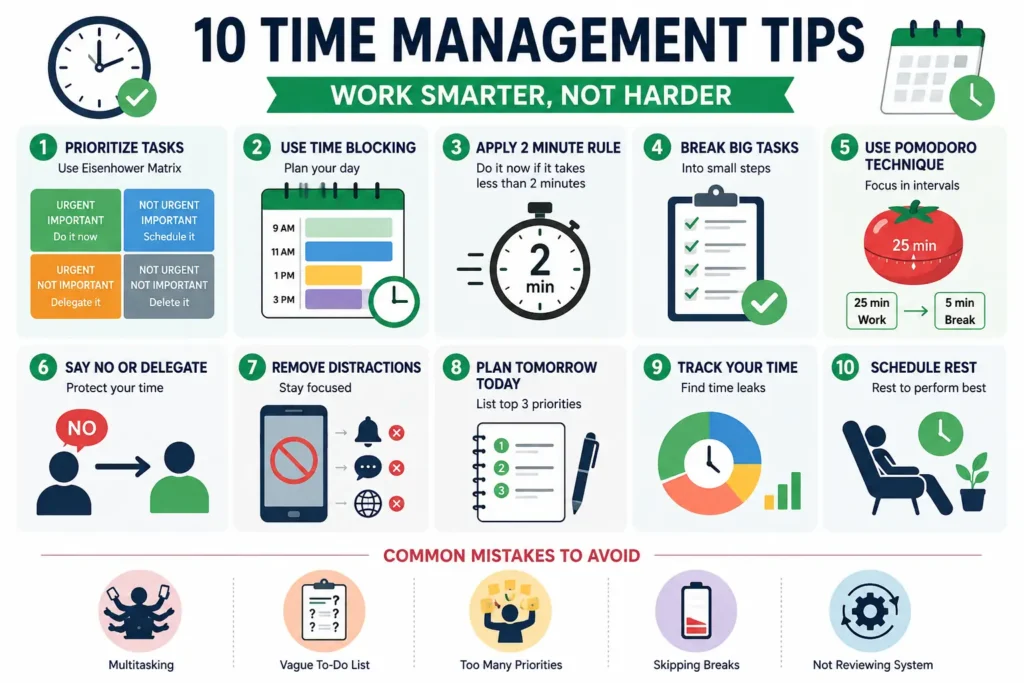
Now, let’s explore practical time management tips that really work, so you can manage your time better and work smarter.
1. Prioritize Tasks Using the Eisenhower Matrix
Not all tasks are equal.
Some are urgent. Some are important. Some are both. Some are neither.
The Eisenhower Matrix sorts every task into four boxes:
| Box | Type | What to Do |
|---|---|---|
| Box 1 | Urgent and Important | Do it now |
| Box 2 | Important, Not Urgent | Schedule it |
| Box 3 | Urgent, Not Important | Delegate it |
| Box 4 | Not Urgent, Not Important | Delete it |
Example: A marketing manager has a client call in one hour. That is Box 1. She also wants to plan next quarter’s strategy. That is Box 2, so she schedules it for Friday. A teammate asks her to review a minor slide deck. That is Box 3, so she asks another colleague to handle it. Scrolling social media between tasks falls into Box 4. She skips it.
This single habit can save hours every week.
2. Use Time Blocking to Take Control of Your Calendar
Time blocking means giving every task its own slot on your calendar.
No vague to do lists. No guessing what to do next.
Just a clear plan, hour by hour.
Example: Instead of writing “Work on project,” a freelance designer blocks they day like this:
- 9:00 to 10:30 AM: Client design draft
- 10:30 to 11:00 AM: Emails and messages
- 11:00 AM to 1:00 PM: Deep work on branding project
- 2:00 to 3:00 PM: Team meeting
- 3:00 to 4:00 PM: Admin and invoicing
This structure removes decision fatigue. She always knows exactly what to do next.
3. Apply the Two Minute Rule to Clear Small Tasks Instantly
If something takes less than two minutes, do it right away.
Do not add it to your list. Do not postpone it.
Example: Replying to a short email, saving a file, or confirming a meeting time all take under two minutes.
Doing these instantly prevents small tasks from piling up into a mountain of mental clutter by the end of the week.
4. Break Big Projects Into Small, Clear Steps
Large tasks feel heavy. That heaviness causes delay.
The fix is simple. Break the task into small steps you can start immediately.
Example: “Launch a new website” feels overwhelming.
Broken down, it becomes:
- Research competitor websites
- Write homepage content
- Design the layout
- Add product pages
- Test on mobile and desktop
- Publish and share
Each step feels achievable. Momentum builds naturally once you start ticking boxes.
5. Use the Pomodoro Technique for Deep Focus
The brain cannot focus for hours without a break. It needs rhythm.
The Pomodoro Technique uses short, focused work sprints followed by short breaks.
How it works:
- Work with full focus for 25 minutes
- Take a 5 minute break
- Repeat four times
- Take a longer 15 to 30 minute break
Example: A student preparing for an exam uses four Pomodoro sessions to cover one chapter, with a short walk between each session. By the end, the chapter is fully revised without the usual mental fatigue.
6. Say No or Delegate What Does Not Need Your Attention
Every yes you give takes time away from something else.
Successful people protect their time by saying no often, and by delegating tasks that do not require their specific skills.
Example: A startup founder used to design his own social media graphics. Once his business grew, he handed that task to a freelancer. That freed up nearly five hours a week, which he redirected toward closing new client deals.
Delegation is not weakness. It is smart time management.
7. Remove Distractions Before They Steal Your Time
Multitasking feels productive. It is actually the opposite.
Every time you switch tasks, your brain needs time to refocus. This is called switching cost, and it quietly eats hours every day.
Simple fixes that work:
- Turn off non essential notifications
- Keep your phone in another room during deep work
- Use website blockers for social media during work hours
- Close unused browser tabs
Small changes like these create large gains in focus and output quality over a full week.
8. Plan Tomorrow Before You End Today
The best time to plan your day is the night before, not the morning of.
Spend just 10 minutes each evening writing down your top three priorities for tomorrow.
Example: A sales executive ends every workday by listing there three most important tasks for the next morning. She starts each day already knowing exactly where to begin, with no time lost deciding what to do first.
This one habit alone can save 20 to 30 minutes of wasted morning time every single day.
9. Track Where Your Time Actually Goes
Most people believe they know how they spend their day.
Most people are wrong.
Keeping a simple time log for one full week reveals hidden time leaks, like unplanned scrolling, long meetings that could have been emails, or constant app switching.
Example: A remote employee tracked there time for a week and discovered she spent almost 90 minutes a day on unplanned Slack conversations. Once she blocked specific times to check messages, she reclaimed over 7 hours a week.
You cannot fix what you do not measure.
10. Schedule Rest as Seriously as You Schedule Work
This is the tip most people ignore. It is also the one that matters most long term.
Working nonstop does not increase output. It reduces it over time through fatigue and burnout.
Example: A software developer used to work through lunch every day, believing it saved time. After tracking his output, he noticed his afternoon coding had far more bugs than his morning work. He started taking a proper lunch break and a short walk, and his error rate dropped noticeably within two weeks.
Rest is not the opposite of productivity. Rest protects productivity.
Common Time Management Mistakes to Avoid
Even good intentions fail without the right habits. Watch out for these common mistakes:
- Multitasking instead of focusing on one task at a time
- Writing vague to do items instead of clear, specific steps
- Overloading each day with too many priorities
- Skipping breaks and running on empty energy
- Never reviewing or adjusting your system when it stops working
Fixing even one of these mistakes can noticeably improve your week.
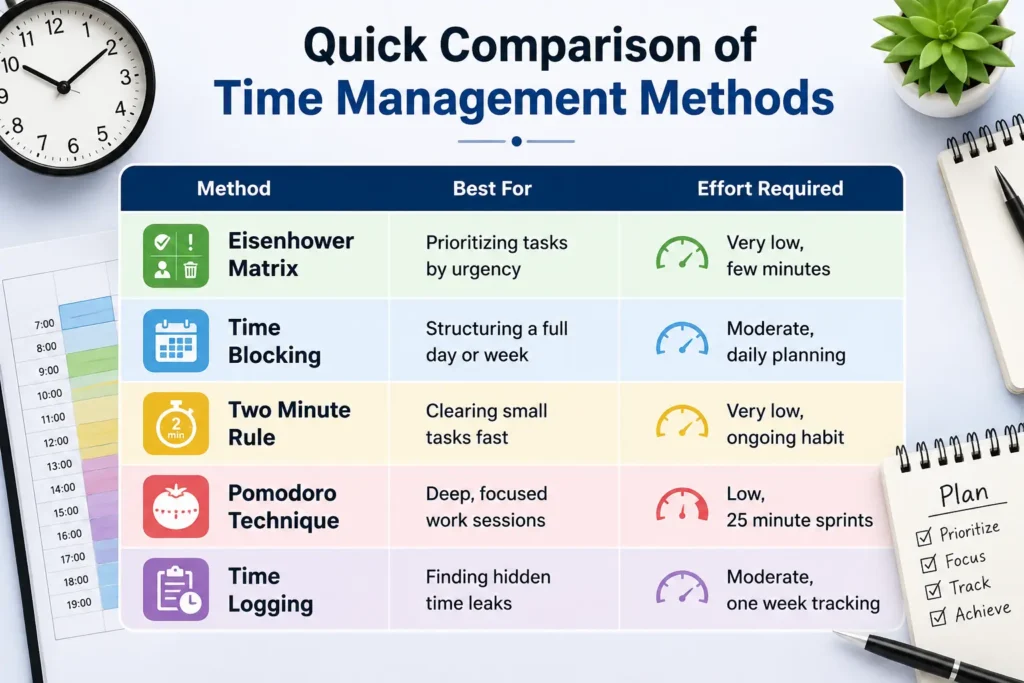
Quick Comparison of Time Management Methods
| Method | Best For | Effort Required |
|---|---|---|
| Eisenhower Matrix | Prioritizing tasks by urgency | Very low, few minutes |
| Time Blocking | Structuring a full day or week | Moderate, daily planning |
| Two Minute Rule | Clearing small tasks fast | Very low, ongoing habit |
| Pomodoro Technique | Deep, focused work sessions | Low, 25 minute sprints |
| Time Logging | Finding hidden time leaks | Moderate, one week tracking |
Final Thoughts
Time management is not about squeezing more tasks into your day.
It is about protecting your energy, your focus, and your priorities.
Start small. Pick just one tip from this list, maybe time blocking or the two minute rule, and use it for one full week.
Once it feels natural, add another.
Small, consistent habits build real change over time, and that change compounds week after week until managing your time feels effortless instead of exhausting.