

How to Write SMART Goals: Examples, Tips & Templates
Most people fail at their goals not because they lack motivation, but because their goals are too vague to act on. Saying “I want to get fit” or “I want to grow my business” feels good for a moment, but it gives your brain nothing solid to work with. This is where the SMART goals framework comes in.
SMART goal setting is one of the oldest and most trusted methods used by managers, coaches, students, and entrepreneurs to turn vague wishes into clear, trackable targets. In this guide, you will learn what SMART goals mean, how to write one step by step, real examples across different areas of life, a ready-to-use template, and common mistakes to avoid.
What Is a SMART Goal?
A SMART goal is a goal that is written with five specific qualities in mind: Specific, Measurable, Achievable, Relevant, and Time-bound. The framework was first introduced by George T. Doran in a 1981 management paper and has since become a standard method in business planning, personal development, and education.
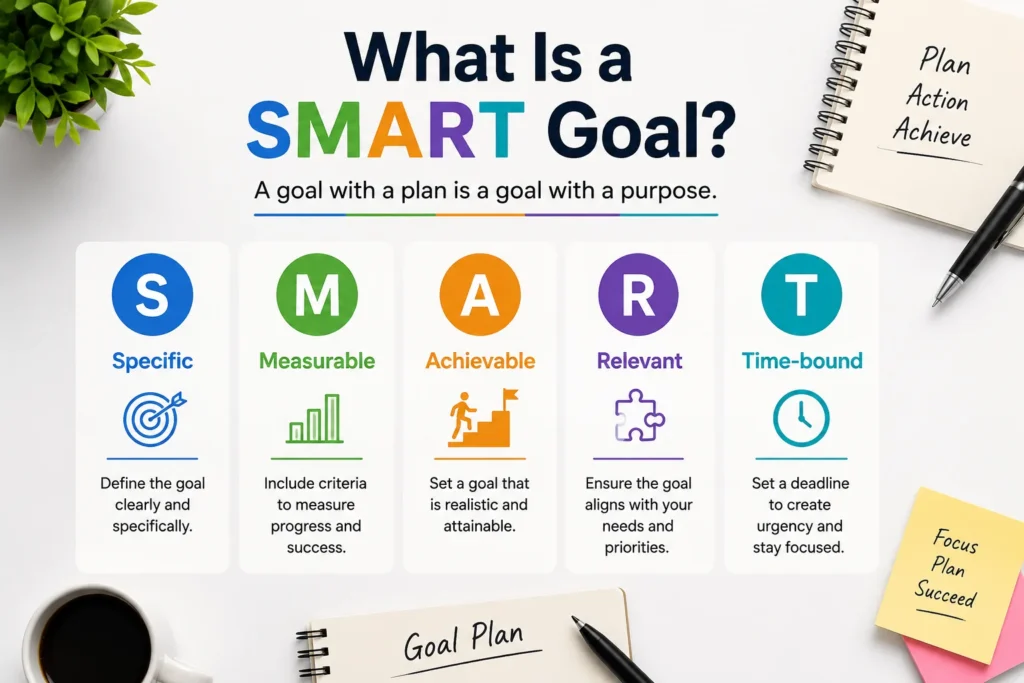
The idea is simple. A goal without structure is just a hope. A goal built on the SMART model becomes a plan you can actually follow and measure.
What Does SMART Stand For
Let us break down each letter of the SMART framework with a clear explanation and example.
S: Specific
Your goal should answer the basic questions: what exactly do you want to achieve, who is involved, and where or how will it happen. A specific goal removes guesswork.
Weak version: I want to read more books. Specific version: I want to read one non-fiction book every month related to marketing.
M: Measurable
A goal must have a way to track progress. Numbers, deadlines, or clear checkpoints turn a wish into something you can measure.
Weak version: I want to save money. Measurable version: I want to save ₹50,000 in the next six months.
A: Achievable
The goal should stretch you but still be realistic given your current time, skills, and resources. Setting a goal that is impossible only leads to frustration and giving up early.
Weak version: I want to double my company revenue in one month. Achievable version: I want to grow my company revenue by 15 percent in the next quarter.
R: Relevant
The goal should matter to your bigger picture. It should connect to your long-term plans, values, or priorities, not just be a random target.
Example: If your long-term goal is to become a senior developer, learning a new programming framework this quarter is relevant. Learning graphic design may not be.
T: Time-bound
Every goal needs a deadline. Without a clear end date, a goal can sit unfinished for years.
Weak version: I will learn Spanish someday. Time-bound version: I will complete a beginner Spanish course by the end of this year.
Why SMART Goals Actually Work
In practice, a goal becomes much easier to act on when you know exactly what needs to happen and when. Saying “I need to manage my time better” sounds good, but it does not tell you what to do next. A goal like “I’ll spend 10 minutes planning tomorrow’s priorities before I finish work each day” gives you a simple action you can actually follow.
This idea also lines up with goal-setting research by psychologists Edwin Locke and Gary Latham, which found that specific, challenging goals tend to improve performance more than vague goals. That is why SMART goals are useful not just at work, but also for time management, business, fitness, studies, and everyday personal goals.
How to Write a SMART Goal Step by Step
Follow these steps whenever you sit down to set a new goal:
- Write your rough goal first. Do not worry about structure yet, just get the idea down.
- Make it specific. Add details about what, who, and where.
- Attach a number or metric. Decide how you will measure success.
- Check if it is realistic. Look at your current time, budget, and skill level honestly.
- Connect it to your bigger purpose. Ask why this goal matters to you right now.
- Set a deadline. Pick an exact date, not “soon” or “eventually.”
- Write the final SMART goal in one clear sentence.
SMART Goal Examples Across Different Areas
Here is a table showing how a weak goal transforms into a SMART goal across common life areas.
| Area | Weak Goal | SMART Goal |
|---|---|---|
| Career | Get better at my job | Complete two online certification courses in project management by December 31 to qualify for a team lead role |
| Health | Get in shape | Exercise for 30 minutes, five days a week, and lose 5 kg in three months |
| Finance | Save more money | Save ₹10,000 every month for the next 12 months by cutting food delivery expenses |
| Study | Improve my grades | Score above 85 percent in the next semester exams by studying two hours daily and joining a weekly study group |
| Business | Increase average purchase value | Increase the average customer purchase by 10% within six months by introducing bundle offers and strategically placing complementary products. |
This table format works well because it shows the direct before-and-after shift, which makes the concept easy to apply to your own goals.
SMART Goals Template
Use this simple fill-in-the-blank template for any goal you want to set:
I will [specific action] by [deadline], measured by [number or metric], because it supports [larger purpose or relevant reason], and it is realistic given [current resources or time].
Example:
I will exercise for 30 minutes, 5 days a week, by December 31, measured by completing at least 20 workout sessions per month, because it supports my goal of improving my overall health and energy, and it is realistic given my current schedule and access to a nearby gym.
More examples:
For Business: I will increase website traffic by 20% within three months, measured by monthly Google Analytics data, because it supports my goal of generating more leads, and it is realistic given my current content and marketing resources.
For Career: I will complete an advanced Excel course by September 30, measured by finishing all 20 modules and earning the certificate, because it supports my goal of improving my job skills, and it is realistic given that I can study for 30 minutes each weekday.
For Academic: I will raise my math grade from 75% to 85% by the end of the semester, measured by my exam and assignment scores, because it supports my goal of improving my academic performance, and it is realistic given that I can study for one hour each day.
You can copy this line into a notebook, spreadsheet, or planning app and reuse it for every new goal.
Common Mistakes People Make With SMART Goals
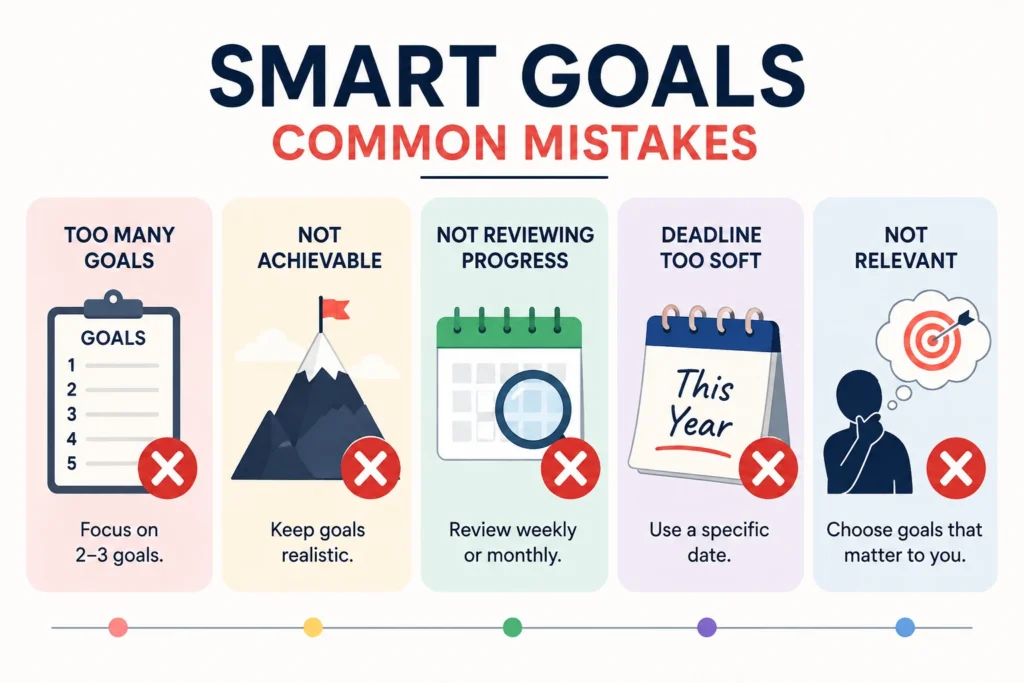
Even with a clear framework, people often make a few repeated errors:
- Setting too many goals at once. Focus on two or three SMART goals at a time rather than ten.
- Ignoring the achievable part. Ambition is good, but an unrealistic target often leads to quitting halfway.
- Forgetting to review progress. A SMART goal is not something you write once and forget. Check it weekly or monthly.
- Making the deadline too soft. Words like “this year” are weaker than an exact date like “by March 31.”
- Writing goals that are not personally relevant. A goal copied from someone else rarely sticks unless it connects to your own priorities.
SMART Goals vs Other Goal-Setting Methods
Some people compare SMART goals with newer frameworks like OKRs (Objectives and Key Results), which are common in startups and tech companies. The main difference is that SMART goals work well for individual, day-to-day targets, while OKRs are often used for team-level and company-wide planning with a mix of ambitious and measurable outcomes. Both methods share the same core idea: clarity beats vague ambition.
SMART Goal FAQs
What does SMART stand for in goal setting?
SMART stands for Specific, Measurable, Achievable, Relevant, and Time-bound. It is a framework used to turn vague goals into clear, actionable plans.
Who created the SMART goals framework?
The concept was introduced by George T. Doran in a 1981 article published in Management Review.
Can SMART goals be used for personal life, not just work?
Yes. SMART goals apply equally well to health, finance, relationships, study, and personal habits, not only business or career targets.
How many SMART goals should I set at one time?
Most experts suggest keeping it to two or three active goals at a time so you can give each one proper attention and tracking.
What is an example of a bad SMART goal?
A bad example is: “I want to be successful this year.” It has no clear metric, deadline, or specific action, which breaks the entire SMART structure.
Final Thoughts
Writing a SMART goal takes only a few extra minutes compared to writing a vague wish, but the difference in results is significant. The next time you set a goal for your career, health, studies, or business, run it through the five SMART checkpoints before you write it down. A clear goal with a number and a deadline is far more likely to actually get done.