What Is a Good ROI for a Business?
Every business owner asks the same question at some point: is my ROI actually good, or am I just breaking even without realizing it. The honest answer is that a good ROI depends on your industry, business model, and risk level. There is no single number that applies to every business. This article explains what ROI really means, what counts as a good benchmark across different situations, and how to judge whether your own numbers are healthy.
What Is ROI?
ROI stands for Return on Investment. It measures how much profit you made compared to how much you spent to get it. The formula is:
ROI = (Net Profit / Total Cost) x 100
Net profit means revenue minus every cost involved, including product cost, marketing, salaries, tools, and overhead. Total cost is everything you spent to generate that revenue.
For example, if you invest ₹50,000 into a campaign or business activity and earn ₹75,000 in profit from it, your ROI is:
ROI = (₹75,000 / ₹50,000) x 100 = 150%
A 150% ROI means your profit is one and a half times your original cost.
Is There a Universal Good ROI Number?
Not really. What counts as good depends heavily on context. A 10% ROI might be excellent for a low risk, stable investment, while the same 10% ROI could be disappointing for a high risk marketing campaign that was expected to perform much better. Because of this, ROI should always be judged against your industry average, your business goals, and the level of risk involved, not against a fixed universal number.
General ROI Benchmarks by Business Type
While there is no single correct number, here are commonly referenced ranges that give a rough sense of what businesses in different situations often consider healthy.
Small Business and Retail
Small businesses, including retail and ecommerce, often aim for an ROI between 15% and 30%. Margins tend to be thinner here due to product costs, packaging, and shipping, so a moderate ROI is often considered solid.
Marketing and Advertising Campaigns
For marketing specific investments, many businesses target an ROI of 200% or higher, sometimes expressed as a 3x or 5x return once ad spend, creative cost, and platform fees are all included. Since marketing is often seen as a growth driver, expectations here tend to be higher than general business ROI.
Real Estate
Real estate investors commonly look for an annual ROI between 8% and 12%, though this varies widely based on location, rental yield, and property appreciation.
Stock Market and Long Term Investments
Long term equity investments have historically averaged an annual ROI of around 7% to 10% over extended periods, though this fluctuates year to year and carries market risk.
Service Based Businesses
Service businesses, such as consulting, agencies, or freelance operations, often see higher ROI because overhead and product costs are lower. An ROI of 30% to 50% is common in service based models.
Factors That Affect What Counts as a Good ROI
Industry Type
Some industries naturally run on thin margins, like grocery or wholesale, while others, like software or digital products, can support much higher ROI due to low reproduction cost.
Risk Level
Higher risk investments generally need a higher expected ROI to justify the risk. A stable, low risk investment can be considered good even at a lower percentage.
Time Frame
A 20% ROI earned in one month is very different from the same ROI earned over three years. Always check the time period behind the number before judging it.
Business Stage
A new business investing heavily in growth might accept a lower or even negative ROI temporarily, expecting stronger returns later. An established business, on the other hand, usually expects consistent positive ROI.
Cost Structure
Businesses with high fixed costs, like manufacturing or physical stores, often see lower ROI than businesses with lower overhead, like digital services.
How to Know If Your ROI Is Actually Good
Instead of chasing a fixed percentage, compare your ROI against these reference points:
- Your own historical performance. Is your ROI improving or declining over time compared to previous months or quarters.
- Industry averages. Research typical ROI ranges for businesses similar to yours in size and sector.
- Cost of capital. Your ROI should be higher than what it would cost you to borrow money or the return you could get from a safer alternative investment.
- Business goals. A campaign meant purely for brand awareness may accept a lower ROI than one meant to directly drive sales.
Common Mistakes When Judging ROI
Comparing ROI across unrelated industries. A 15% ROI in real estate and a 15% ROI in a digital ad campaign do not carry the same meaning.
Ignoring the time period. A high ROI over five years is not the same achievement as the same ROI in one month.
Only looking at revenue instead of net profit. Some businesses calculate ROI using revenue instead of actual profit, which inflates the number and hides real costs.
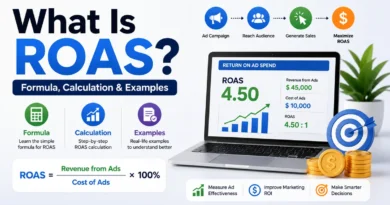
Treating ROAS and ROI as interchangeable. ROAS only measures ad revenue against ad spend, while ROI includes every cost. A strong ROAS does not always mean a strong ROI.
Final Takeaway
There is no single number that defines a good ROI for every business. As a general guide, 15% to 30% ROI is considered healthy for most small businesses, while marketing specific campaigns often aim higher, around 200% or more. The real test is whether your ROI is higher than your cost of capital, consistent with or better than your industry average, and improving over time. Track it regularly, compare it to relevant benchmarks, and use it alongside other metrics like ROAS and profit margin for a complete picture of business health.