AI vs Human Intelligence: Key Differences Explained
In today’s fast changing world, Artificial Intelligence (AI) is becoming more powerful every day. From smartphones to self driving cars, AI is helping us in ways we couldn’t imagine a few years ago. But this rise of technology brings up an important question: How is AI different from Human Intelligence?
In this article, we’ll clearly explain the key differences between AI and human intelligence in simple English, so you can understand how both work, where each shines, and what the future may hold.
If you’re new to AI, you can quickly check the AI Glossary for Beginners to understand the basic terms before moving ahead.
What Is Artificial Intelligence (AI)?
Artificial Intelligence (AI) is the ability of machines or computer systems to perform tasks that normally require human intelligence. These tasks include learning, reasoning, problem solving, and even understanding languages.
AI uses algorithms, big data, and neural networks to simulate human thinking.
Examples of AI include:
Chatbots like ChatGPT
Virtual assistants (Siri, Alexa, Google Assistant)
Self driving cars
Facial recognition systems
AI tools for medical diagnosis
AI is built and trained by humans: it learns from data and experience, but it does not have emotions or consciousness.
What Is Human Intelligence?
Human intelligence is the natural ability of people to think, reason, learn, and adapt to different situations. It is influenced by emotions, environment, creativity, and moral values.
Humans can understand abstract concepts, build relationships, and express empathy, something AI still cannot do.
Examples of human intelligence:
Solving a complex problem creatively
Writing poetry or music
Making emotional decisions
Learning from social interactions
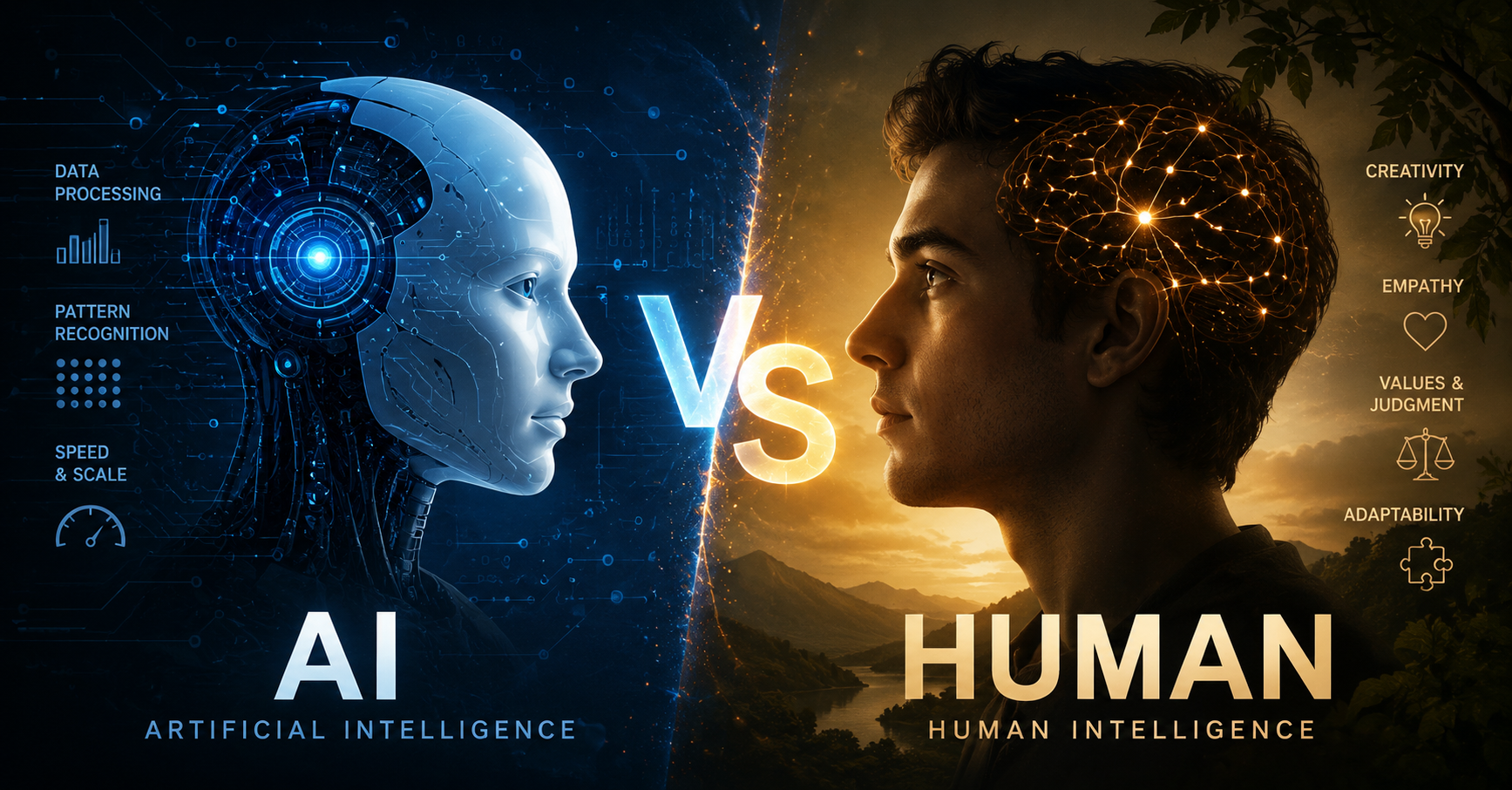
AI vs Human Intelligence: Key Differences
| Factor | Artificial Intelligence (AI) | Human Intelligence |
|---|---|---|
| Origin | Created by humans using code and data | Natural and biological |
| Learning Method | Learns from data and patterns | Learns from experiences, emotions, and environment |
| Creativity | Limited creativity (based on data input) | Highly creative and imaginative |
| Speed & Accuracy | Very fast and accurate in repetitive tasks | Slower, but more flexible and adaptable |
| Decision Making | Based on logic and data only | Based on logic, emotions, and ethics |
| Memory | Stores huge amounts of data without forgetting | Limited memory capacity, can forget over time |
| Emotions | No emotions or feelings | Emotions influence thoughts and actions |
| Adaptability | Needs reprogramming to adapt | Adapts naturally to new situations |
| Error Handling | Fewer errors in repetitive work | Can make mistakes due to fatigue or bias |
| Ethical Understanding | No moral judgment | Has ethical, social, and emotional awareness |
Strengths of Artificial Intelligence
Efficiency: AI can process large data sets much faster than humans.
Accuracy: Perfect for tasks requiring precision like medical imaging or manufacturing.
Availability: Works 24/7 without rest.
Automation: Reduces human effort in repetitive tasks.
Data Analysis: Helps businesses and scientists make better data driven decisions.
Strengths of Human Intelligence
Creativity: Humans can think outside the box and create original ideas.
Empathy and Emotions: We can connect emotionally with others, something AI cannot do.
Moral Values: Humans can make ethical decisions based on society’s rules and beliefs.
Adaptability: People can adjust to changing environments easily.
Learning from Experience: We can learn from both success and failure, not get just a data.
Can AI Replace Human Intelligence?
The simple answer is No, at least not completely.
AI can outperform humans in specific areas like data processing, automation, and pattern recognition, but it still lacks emotion, consciousness, and ethical understanding.
AI complements human intelligence rather than replacing it. For example:
In medicine, AI helps doctors analyze scans faster, but doctors make the final decision.
In education, AI tools help personalize learning, but teachers guide and motivate students.
The best results come from AI and humans working together known as “Augmented Intelligence.”
The Future of AI and Human Collaboration
In the future, we will see more human and AI partnerships where machines handle data heavy tasks, and humans focus on creativity, strategy, and empathy.
For example:
AI in healthcare: Early disease detection, but human doctors for care and empathy.
AI in business: Data analytics by AI, decisions by human managers.
AI in art: AI tools for design assistance, but creativity from humans.
As AI grows, we must ensure it remains ethical, transparent, and human centered.
Conclusion
The debate of AI vs Human Intelligence isn’t about competition, it’s about collaboration.
AI brings speed, precision, and automation, while human intelligence adds creativity, emotional depth, and moral understanding.
When both work together, they create a powerful combination that can drive innovation and improve our lives in countless ways.
Key Takeaways
AI learns from data; humans learn from life experiences.
AI lacks emotions, creativity, and ethics, humans don’t.
The future is not “AI vs Humans” but “AI + Humans.”