
High Vitamin B12 Levels: Causes, Symptoms & What They Mean
High vitamin B12 levels (medical term: hypercobalaminemia) mean the blood holds more B12 than the laboratory’s reference range expects.
The most common cause is high dose supplements or B12 injections, and the level usually falls once the extra intake stops.
When no supplement is being taken, a high result can point to liver disease, kidney disease, or a blood disorder, so it needs a doctor’s review.
What Are High Vitamin B12 Levels?
Vitamin B12, also called cobalamin, is a water soluble vitamin needed for red blood cell production, nerve function and DNA synthesis.
The body removes most excess B12 through urine and stool, which is why a high level from food alone is very rare. Some B12 is stored in the liver, and damaged liver cells can release it into the blood.
No tolerable upper intake level has been set for B12. That means there is no official number above which B12 is declared toxic.
A level is called high only when it sits above the reference range printed on the lab report.
NNormal vs High B12 Range
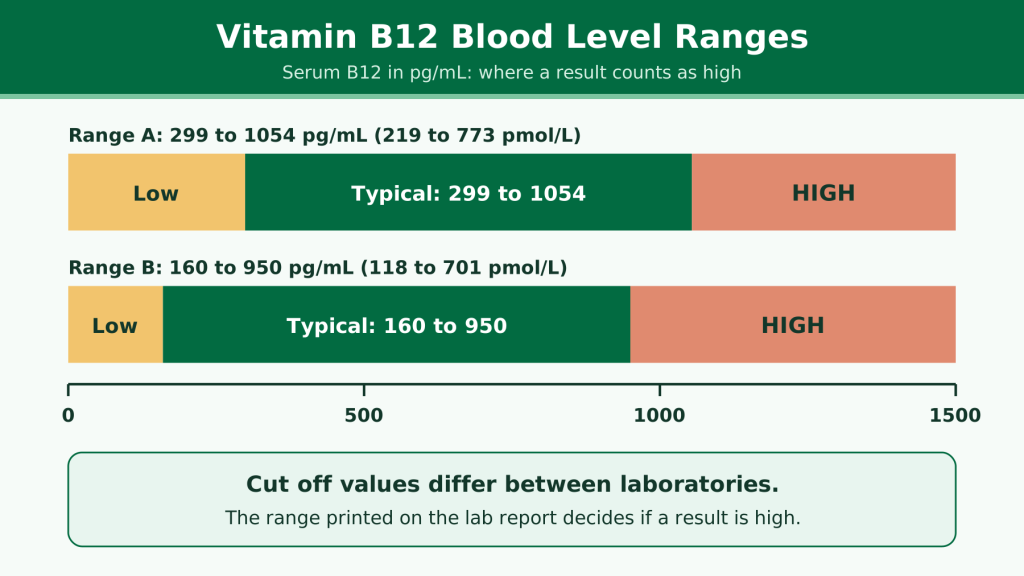
Reference ranges differ between laboratories and test methods, so a single cutoff cannot be quoted for every lab. Two commonly published ranges show how much the limits can vary.
| Result zone | Range A: pg/mL (pmol/L) | Range B: pg/mL (pmol/L) | What it means |
|---|---|---|---|
| Low | Below 299 (219) | Below 160 (118) | Possible B12 deficiency, confirmed with further testing |
| Typical | 299 to 1054 (219 to 773) | 160 to 950 (118 to 701) | Within the laboratory’s normal range |
| High | Above 1054 (773) | Above 950 (701) | Flagged high, and the cause needs to be found |
The gap between the two ranges matters in practice. A result of 1,000 pg/mL is typical on Range A but flagged high on Range B. For this reason, the reference range printed on the lab report is the one that decides whether a result is high.
Range A comes from the US National Library of Medicine (MedlinePlus). Range B is a lower limit set that some laboratories use. If you want Range B attributed to a neutral source instead, tell me which one and I will match it.
Causes of High Vitamin B12 Levels
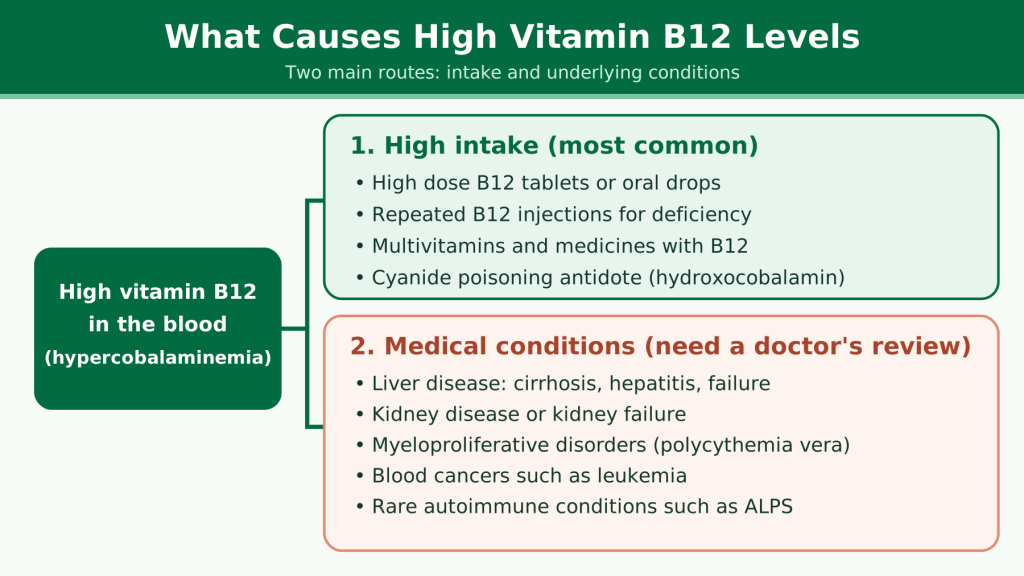
High B12 happens in two main ways: high intake, or an underlying condition that raises B12 in the blood.
High Intake From Supplements and Injections
Supplements and injections are the most common reason. Vitamin B12 deficiency is common, and experts suspect it affects up to 2 in 5 people worldwide, so many people receive B12 to correct it.
Oral tablets or drops are usually enough, and injections are used when oral treatment fails.
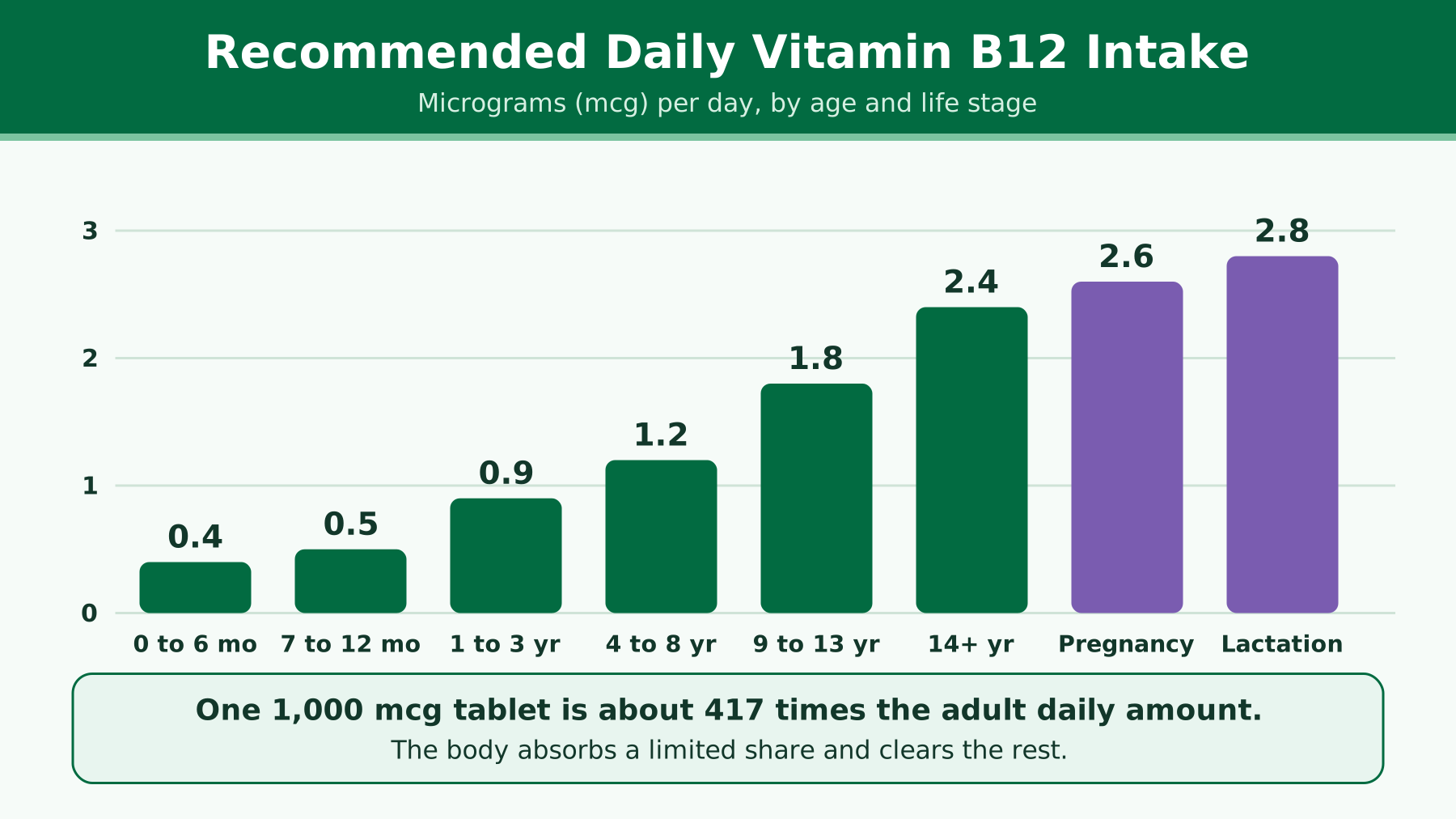
Food is rarely the cause. A 3 ounce serving of salmon provides about 2.7 mcg of B12, just above the adult recommended daily amount of 2.4 mcg.
The body cannot absorb all B12 at once, so the excess leaves in urine and stool.
In practice, the numbers explain most high results. A single 1,000 mcg tablet equals about 417 times the adult daily amount (1,000 ÷ 2.4). A person taking such a tablet daily, or receiving repeated injections, can easily end up above the lab’s range.
Underlying Medical Conditions
When B12 is high without supplements, the cause may be a condition that changes how B12 is released, bound or cleared. Examples include:
- Liver disease, including cirrhosis, hepatitis and liver failure. Damaged liver cells can release stored B12 into the blood.
- Kidney disease or kidney failure, where reduced clearance can raise serum B12.
- Myeloproliferative disorders, such as polycythemia vera, where abnormal blood cell production raises B12 binding proteins.
- Blood cancers, such as leukemia.
- Autoimmune conditions, such as autoimmune lymphoproliferative syndrome (ALPS). This is rare, and the evidence is limited.
A review by Andrès and colleagues in the journal QJM (2013) covers how these conditions raise B12, and Ermens and colleagues (Clinical Biochemistry, 2003) describe the clinical meaning of raised B12 levels.
Supplement Related vs Condition Related High B12
| Feature | Supplement or injection related | Condition related |
|---|---|---|
| Usual trigger | High dose B12 tablets, drops or injections | Liver, kidney or blood disorder |
| Level after extra B12 stops | Falls as the body clears the excess | Stays raised until the cause is treated |
| Typical symptoms | None, or rare symptoms at very high doses | Symptoms of the underlying condition |
| Usual next step | Review the dose with a doctor | Tests to find and treat the cause |
Who Is at Higher Risk?
The main risk factor is needing B12 treatment. Reasons for such treatment include:
- Age: deficiency is more common after 65.
- Digestive conditions: pernicious anemia and Crohn’s disease reduce B12 absorption.
- Vegetarian and vegan diets: unfortified plant foods do not supply B12.
- Medicines and surgery: proton pump inhibitors, metformin and gastric bypass can lower B12 absorption.
People with chronic liver disease, chronic kidney disease or bone marrow disorders also have a higher chance of a raised result.
Symptoms of High Vitamin B12 Levels
Most people with high B12 have no symptoms. When symptoms occur, they are often linked to the underlying condition or to very high doses rather than to the vitamin itself.
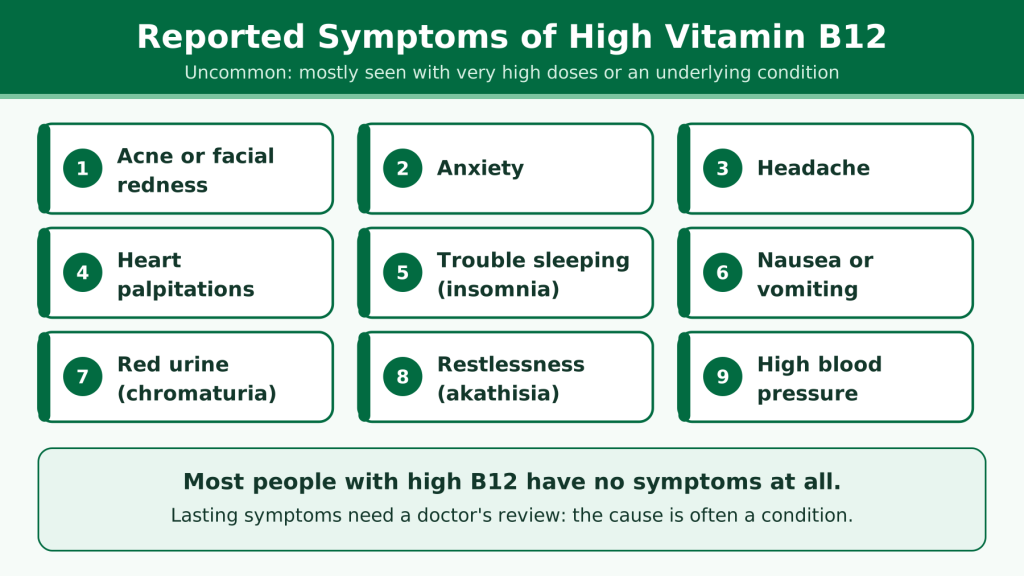
Reported symptoms include:
- Acne or redness of the face
- Anxiety
- Headache
- Heart palpitations
- Insomnia
- Nausea and vomiting
- Red colored urine (chromaturia), which is not the same as blood in urine
- Difficulty sitting still (akathisia)
- High blood pressure
- Fatigue and dizziness, reported mainly alongside an underlying condition
- Tingling, numbness or muscle problems, described in one published case report
Real cases show how high the dose has to be.
A case report in Clinical Toxicology (Morales-Gutierrez and colleagues) described a young woman treated for severe pernicious anemia with repeated 1 mg doses of cyanocobalamin.
Symptoms appeared only after a total of about 15 mg (15,000 mcg) had been injected over several weeks. She developed acne, palpitations, anxiety, uncontrollable movements, facial redness, headache and insomnia. The total dose is about 6,250 times the adult daily amount (15,000 ÷ 2.4).
What Do High B12 Levels Mean?
When Supplements Are the Cause
High B12 from supplements is not considered dangerous in the short term, and any symptoms that occur are unpleasant but pass once intake drops. Researchers still suspect that persistently high levels may matter over a longer period.
A 2024 systematic review and meta analysis in Archives of Gerontology and Geriatrics (Liu and colleagues) studied the link between B12 levels and the risk of death, which is one reason doctors do not ignore unexplained results.
When a Condition Is the Cause
In this case, B12 works as a marker rather than a problem.
A case-control study in the Journal of Clinical Medicine (Urbanski and colleagues, 2020) examined elevated B12 and solid cancers, and a 2024 study in Revista Clínica Española (Pardo Lledias and colleagues) examined raised B12 found by chance and its link with neoplasms.
These are observational studies. They do not show that B12 causes disease. They show why an unexplained high result, with no supplement use, deserves a check of the liver, kidneys and blood.
How High B12 Is Diagnosed
A serum vitamin B12 test needs a blood sample. Fasting for about 6 to 8 hours is advised before the test. Some medicines can affect the result, including colchicine, H2 blockers, metformin, neomycin, phenytoin and proton pump inhibitors. No medicine should be stopped without a doctor’s advice.
A doctor also asks about diet, supplements, symptoms and medical history. Further tests depend on the findings.
| Test | What it checks |
|---|---|
| Serum vitamin B12 | The amount of B12 in the blood |
| Methylmalonic acid (MMA) | Whether the body is using B12 properly, even when the B12 level looks normal |
| Complete blood count (CBC) | Red cells, white cells and platelets, which can point to a blood disorder |
| Liver function tests | Whether liver damage could be releasing B12 |
| Kidney function tests | Whether reduced kidney function is raising B12 |
How to Lower High Vitamin B12 Levels
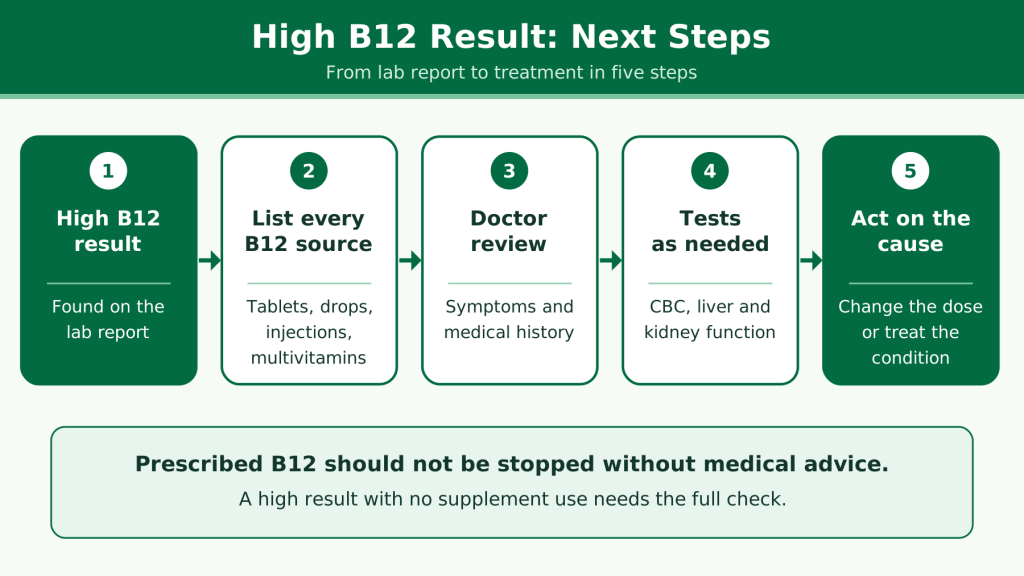
There is no antidote or direct treatment for high B12. The only way to bring the level down is to stop adding B12 and let the body clear the excess, or to treat the condition that caused the rise.
- List every B12 source. Include tablets, drops, injections, multivitamins, and any medicine that contains B12.
- Compare the label dose with the daily amount. Adults need 2.4 mcg a day, rising to 2.6 mcg in pregnancy and 2.8 mcg while breastfeeding.
- Discuss the dose with the prescribing doctor. If the level is high only because of a supplement and there are no symptoms, the doctor may allow the same dose to continue.
- Keep prescribed B12 going until a doctor advises a change. Stopping treatment for deficiency without advice can bring the deficiency back.
- Investigate the cause when no B12 is being taken. Tests for the liver, kidneys, and blood come first.
- Treat the underlying condition. The B12 level usually settles as the condition is managed.
Can High B12 Be Prevented?
Intake-related high levels can be reduced with a few habits:
- Get B12 checked as part of an annual physical.
- Ask a doctor before starting any supplement, since over-the-counter does not mean risk-free.
- Eat a varied diet. Food alone rarely raises B12 above the range.
FAQs: High Vitamin B12 Levels
Is a high vitamin B12 level dangerous?
A high B12 level from food or supplements is usually not dangerous. Toxic effects need extremely high doses. A high level with no supplement use can signal a liver, kidney or blood condition, so it should be checked.
What level of vitamin B12 is considered high?
A level is high when it sits above the upper limit of the reference range on the lab report. Published ranges run from about 160 to 950 pg/mL up to 299 to 1054 pg/mL (118 to 773 pmol/L). Ranges differ by laboratory and method.
Can supplements or food cause high B12?
Supplements and injections can raise B12 above the range, especially at high doses. Food rarely does, because the body absorbs only a limited amount at a time and removes the rest.
Can high B12 be a sign of cancer?
Rarely, yes. Raised B12 has been linked with blood cancers and some solid cancers in observational studies. Most high results come from supplements, and a doctor decides whether further tests are needed.
What should be done after a high B12 result?
The first step is to list all Vitamin B12 food sources and share the list with a doctor. If no B12 is being taken, tests for the liver, kidneys, and blood are the usual next step.