

What Is Working Capital? Formula, Types, and Examples
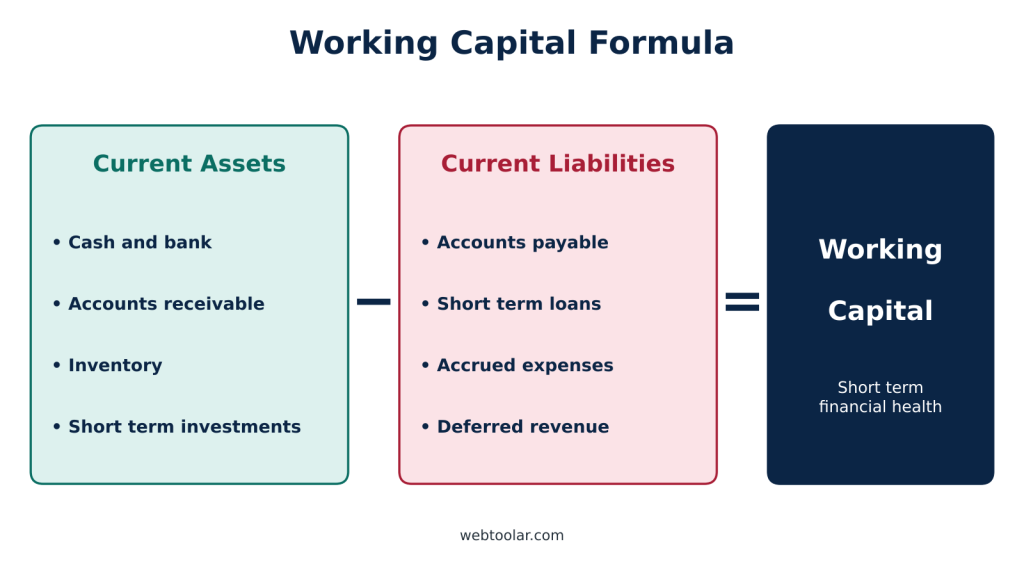
Working capital is the money a business has available to run its daily operations. It is calculated as current assets minus current liabilities. A positive result means the business can pay its short term bills from assets it expects to turn into cash within 12 months.
Working capital is also called net working capital (NWC). Lenders, investors and business owners use it to check short term financial health, liquidity and operating efficiency.
Working Capital Formula
The standard working capital formula is:
Working Capital = Current Assets − Current Liabilities
Both inputs come from the balance sheet.
What Counts as Current Assets
Current assets are items that are cash or expected to become cash within one year.
- Cash and bank balances
- Accounts receivable (money customers owe)
- Inventory (raw materials, work in progress, finished goods)
- Short term investments and marketable securities
- Prepaid expenses such as advance rent or insurance
What Counts as Current Liabilities
Current liabilities are obligations due within one year.
- Accounts payable (money owed to suppliers)
- Short term loans and the current portion of long term debt
- Accrued expenses such as wages, taxes and utilities
- Deferred revenue (advance payments for goods or services not yet delivered)
Working Capital Example With Calculation
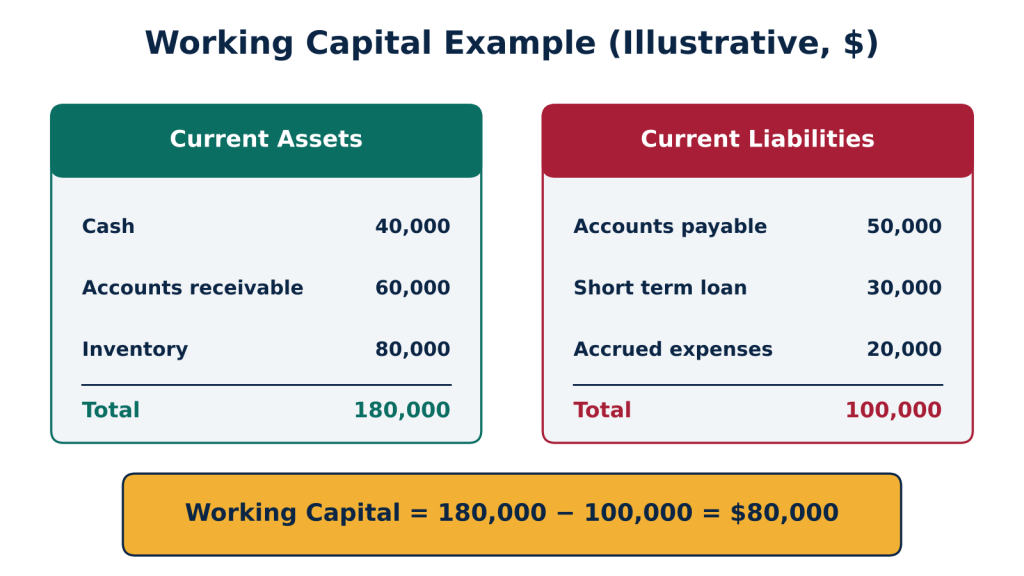
The figures below are illustrative, for a small trading company.
| Item | Amount ($) |
|---|---|
| Cash | 40,000 |
| Accounts receivable | 60,000 |
| Inventory | 80,000 |
| Total current assets | 180,000 |
| Accounts payable | 50,000 |
| Short term loan | 30,000 |
| Accrued expenses | 20,000 |
| Total current liabilities | 100,000 |
Working capital = 180,000 − 100,000 = $80,000
The company holds $80,000 more in short term assets than short term obligations. In practice, a number alone says little. It must be read against the size of the business, its industry and how fast inventory and receivables convert to cash.
Types of Working Capital
Working capital is classified in two ways: by concept and by time period.
Based on Concept
- Gross working capital: total current assets, without subtracting liabilities.
- Net working capital: current assets minus current liabilities. This is the figure most people mean.
Based on Time Period
- Permanent (fixed) working capital: the minimum level of current assets a business always needs, even in a slow month.
- Temporary (variable) working capital: extra funds needed for seasonal peaks, bulk orders or short term growth.
Other Common Classifications
- Operating working capital: current assets and liabilities tied to core operations only, usually excluding cash and short term debt.
- Seasonal working capital: funds needed for predictable peaks, such as retail stock before a festival season.
- Reserve working capital: a buffer kept for emergencies like delayed payments or price shocks.
Comparison Table: Types of Working Capital
| Type | Meaning | Changes With Sales? | Typical Funding Source |
|---|---|---|---|
| Gross | Total current assets | Yes | Mixed |
| Net | Current assets minus current liabilities | Yes | Mixed |
| Permanent | Minimum level always required | No | Long term funds |
| Temporary | Extra need during peaks | Yes | Short term loans, credit lines |
| Seasonal | Predictable seasonal rise | Yes, cyclical | Overdraft, trade credit |
| Reserve | Emergency buffer | No | Retained profit |
Positive vs Negative Working Capital
| Factor | Positive Working Capital | Negative Working Capital |
|---|---|---|
| Meaning | Current assets exceed current liabilities | Current liabilities exceed current assets |
| Liquidity | Bills can be paid from short term assets | Short term bills may be hard to pay |
| Common signal | Stable operations | Cash stress, or a very efficient business model |
| Risk | Idle cash or excess inventory | Missed payments, supplier pressure |
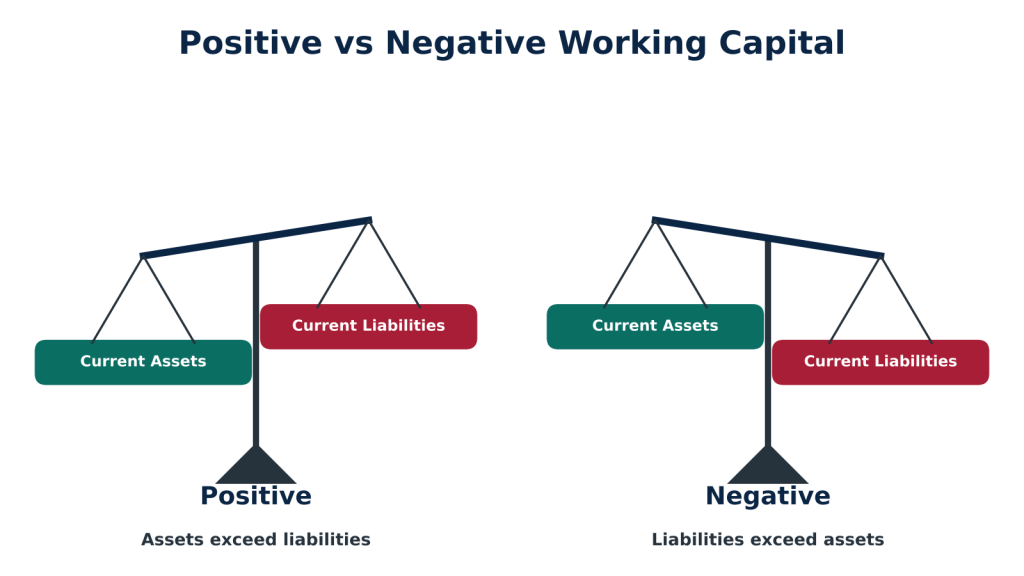
Negative working capital is not always a problem. Supermarkets, restaurants and subscription businesses collect cash quickly and pay suppliers later, so they often run with negative or very low working capital by design. For a manufacturer with slow paying customers, the same result is a warning sign.
Working Capital Ratio (Current Ratio)
The working capital ratio, also called the current ratio, shows liquidity as a multiple.
Working Capital Ratio = Current Assets ÷ Current Liabilities
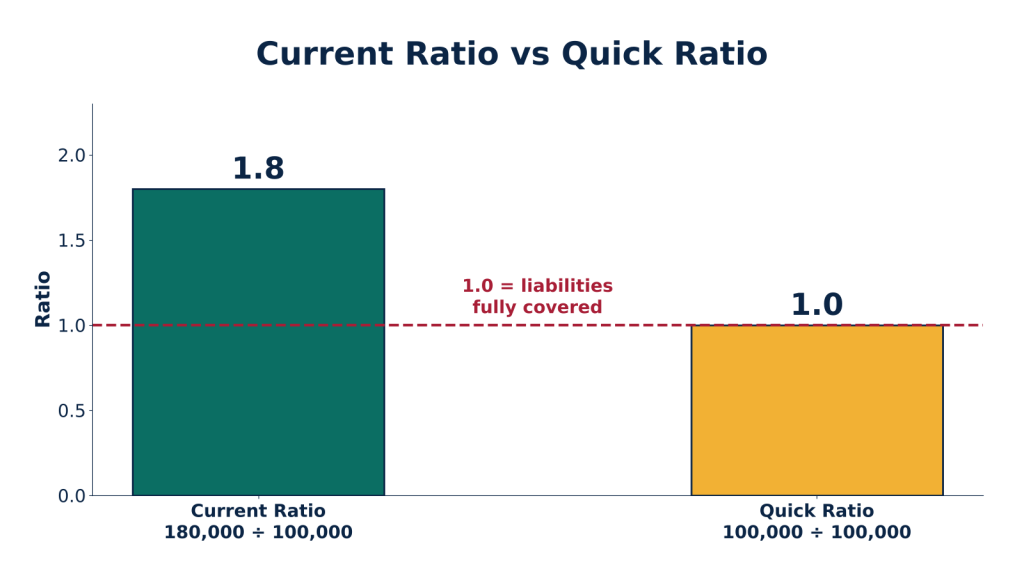
Using the example above: 180,000 ÷ 100,000 = 1.8
How to Read the Ratio
| Ratio | General Interpretation |
|---|---|
| Below 1.0 | Current liabilities exceed current assets; liquidity risk |
| 1.0 to 1.2 | Tight; little room for error |
| 1.2 to 2.0 | Commonly viewed as healthy for most industries |
| Above 2.0 | Strong liquidity, but cash or stock may be sitting idle |
These ranges are rules of thumb. Acceptable levels differ by industry, so a ratio should be compared with similar companies.
A good ROI also changes by industry, in the same way a healthy working capital ratio does.
Quick Ratio
The quick ratio removes inventory, since stock can take time to sell.
Quick Ratio = (Cash + Receivables + Short Term Investments) ÷ Current Liabilities
Example: (40,000 + 60,000) ÷ 100,000 = 1.0
A quick ratio of 1.0 means the company can cover current liabilities without selling any inventory.
Working Capital Cycle and Cash Conversion Cycle
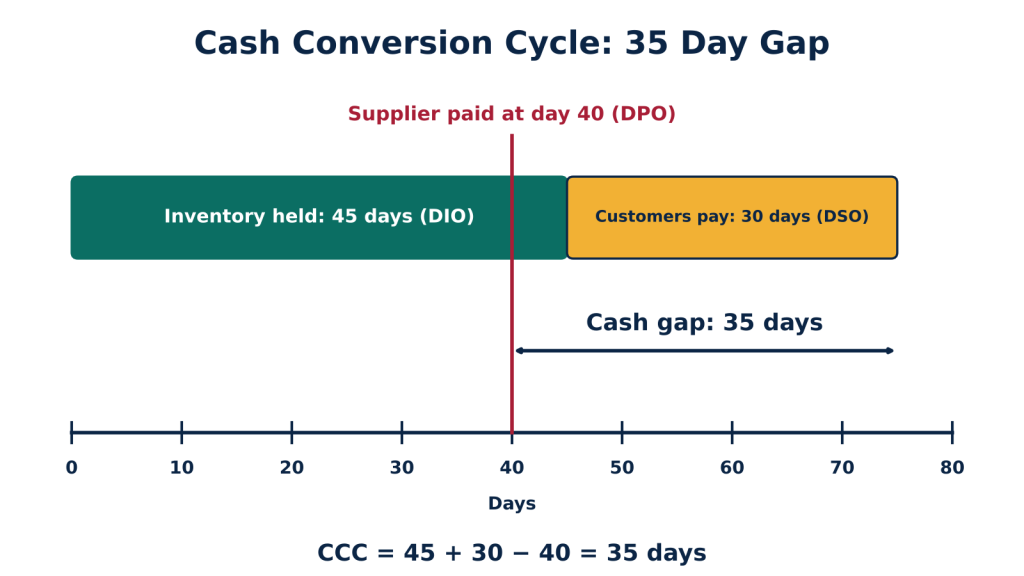
The working capital cycle is the time between paying for inventory and collecting cash from the sale. It is measured as the cash conversion cycle (CCC).
CCC = Days Inventory Outstanding + Days Sales Outstanding − Days Payables Outstanding
Example with illustrative numbers:
- Days Inventory Outstanding (DIO): 45 days
- Days Sales Outstanding (DSO): 30 days
- Days Payables Outstanding (DPO): 40 days
CCC = 45 + 30 − 40 = 35 days
The business funds its operations for 35 days before cash returns. Shortening this cycle frees up cash without needing a loan. Annual working capital surveys from The Hackett Group track how large companies manage inventory, receivables and payables, and they are a useful reference for benchmarking cash conversion.
Working Capital Turnover Ratio
The working capital turnover ratio shows how much revenue each unit of working capital generates.
Turnover = Net Sales ÷ Average Working Capital
Example: annual sales of $600,000 and working capital of $80,000 give 600,000 ÷ 80,000 = 7.5. The company generates a return on investment of $ 7.50 of sales for every $1 of working capital. A higher figure suggests efficient use, though an extremely high figure can mean the business is underfunded.
Why Working Capital Matters
- Pays daily costs: salaries, rent, supplier invoices and utilities depend on available short term funds.
- Supports growth: larger orders need more inventory and longer credit periods before cash arrives.
- Affects borrowing: banks often check working capital and the current ratio before approving credit lines.
- Reduces risk: a sufficient buffer helps a business survive late customer payments or sudden cost increases.
How to Improve Working Capital
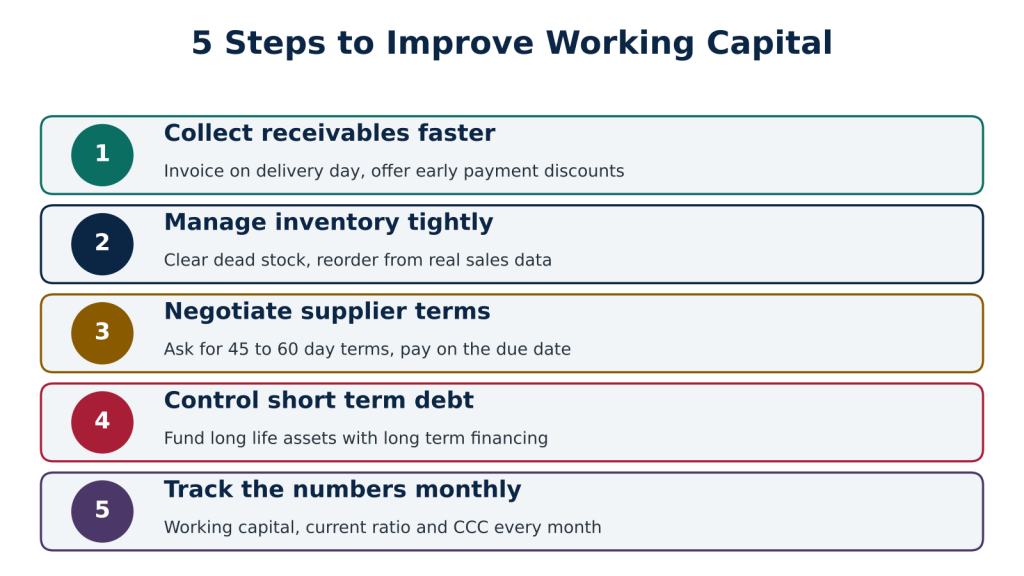
Working capital can be improved by speeding up inflows, slowing outflows within agreed terms, and cutting idle stock.
Step 1: Collect Receivables Faster
Send invoices on the day of delivery, offer small early payment discounts and follow up on overdue accounts weekly.
Step 2: Manage Inventory Tightly
Track slow moving items, reorder based on actual sales data and clear dead stock. Excess inventory ties up cash that could pay bills.
Step 3: Negotiate Better Supplier Terms
Ask for 45 or 60 day payment terms where possible. Pay on the due date, not earlier, unless a discount justifies it.
Step 4: Control Short Term Debt
Replace expensive short term borrowing with longer term financing for assets that last several years.
Step 5: Track the Numbers Monthly
Calculate working capital, current ratio and CCC every month. A downward trend is visible early, when it is cheaper to fix.
Common Working Capital Mistakes
- Treating a high working capital figure as always good, when it may reflect unsold inventory.
- Funding permanent working capital needs with short-term loans.
- Ignoring seasonal peaks in cash planning.
- Counting overdue receivables as fully collectable current assets.
- Looking at working capital once a year instead of monthly.
- Judging ad campaigns by ROAS alone. Ad spend is paid before customers pay, so it ties up cash, and the cash conversion cycle matters as much as the ratio.
Limitations of Working Capital
Working capital is a snapshot taken on one date. It does not show the timing of cash flows inside the period, the quality of receivables, or whether inventory will sell at book value. It should be read together with the cash flow statement and other liquidity ratios.
FAQs About Working Capital
What is working capital in simple words?
Working capital is the difference between what a business owns in short term assets and what it owes in short term bills. It shows whether the business can cover its near term expenses. The formula is current assets minus current liabilities.
What is a good working capital ratio?
A ratio between 1.2 and 2.0 is generally seen as healthy. Below 1.0 signals possible trouble paying short term debts. Above 2.0 may mean cash or inventory is not being used well.
Can working capital be negative?
Yes. Negative working capital means current liabilities are higher than current assets. It can be risky for most firms, but businesses that collect cash before paying suppliers, such as grocery chains, often run this way safely.
Is working capital the same as cash flow?
No. Working capital is a balance sheet figure at one point in time, while cash flow tracks money moving in and out over a period. A business can show positive working capital and still face a cash shortage if receivables are slow.
How do you calculate net working capital?
Add all current assets, add all current liabilities, then subtract liabilities from assets. For example, $180,000 in current assets minus $100,000 in current liabilities gives $80,000 of net working capital.
What is the difference between working capital and current ratio?
Working capital is an absolute amount in currency, while the current ratio is a multiple. Working capital of $80,000 and a current ratio of 1.8 describe the same position in two different ways.