What Is ROAS? Formula, Calculation & Examples
If you run any kind of paid advertising, ROAS is one of the first numbers you need to understand. It tells you whether your ad spend is actually generating revenue, and by how much. This article explains what ROAS means, the formula behind it, how to calculate it step by step, and real examples that show how to read the number correctly.
What Is ROAS?
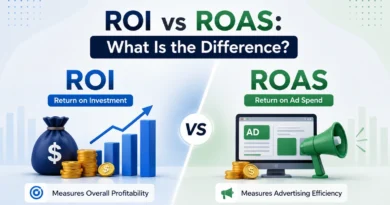
ROAS stands for Return on Ad Spend. It measures how much revenue your advertising generates compared to how much you spent on those ads. Unlike ROI, which factors in every business cost, ROAS only looks at ad spend and the revenue directly tied to it.
ROAS is one of the most common metrics used inside platforms like Google Ads, Meta Ads, and Amazon Ads, because it gives a fast, campaign level view of ad performance without needing to pull in product cost or overhead data.
ROAS Formula
The formula for ROAS is simple:
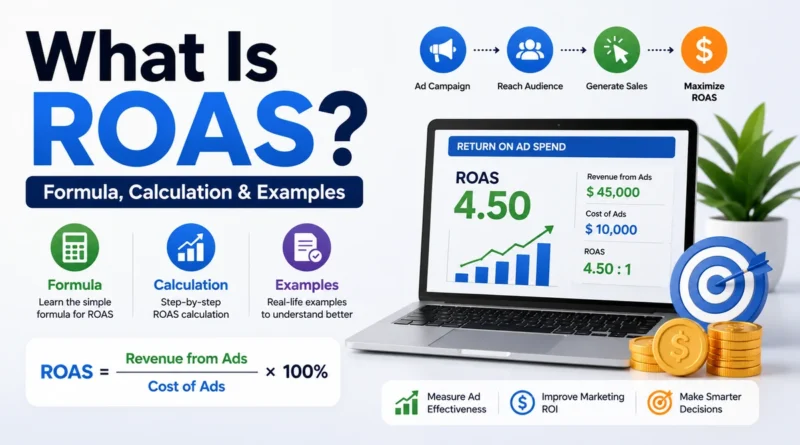
ROAS = Revenue from Ads / Ad Spend
- Revenue from Ads is the total sales generated directly from a specific ad or campaign.
- Ad Spend is the total amount spent running that ad or campaign.
The result is usually shown as a ratio, such as 4x, meaning four rupees earned for every one rupee spent. It can also be expressed as a percentage, where 4x becomes 400%.
How to Calculate ROAS Step by Step
Step 1: Find your total ad spend. This includes everything spent on the specific campaign, such as daily budget, boosted posts, or platform fees tied directly to that campaign.
Step 2: Find your total revenue from that ad. This is the total sales value generated from the campaign, usually tracked through conversion tracking, pixel data, or attribution reports inside the ad platform.
Step 3: Divide revenue by ad spend. Use the formula ROAS = Revenue from Ads / Ad Spend to get your ratio.
Step 4: Convert to a ratio or percentage. Express the result as a multiplier, like 3x, or as a percentage, like 300%, depending on how your team prefers to report it.
ROAS Calculation Examples
Example 1: Basic Calculation
You spend ₹5,000 on a Facebook ad campaign. It generates ₹20,000 in sales.
ROAS = ₹20,000 / ₹5,000 = 4x
This means you earned four rupees in revenue for every rupee spent on ads.
Example 2: Comparing Two Campaigns
Campaign A: Ad spend of ₹8,000, revenue of ₹24,000 ROAS = ₹24,000 / ₹8,000 = 3x
Campaign B: Ad spend of ₹8,000, revenue of ₹40,000 ROAS = ₹40,000 / ₹8,000 = 5x
Even though both campaigns had the same ad spend, Campaign B is performing better, since it generates more revenue per rupee spent. This kind of side by side comparison is where ROAS is most useful, helping you decide which campaign deserves more budget.
Example 3: Low ROAS Scenario
You spend ₹15,000 on ads and generate only ₹12,000 in revenue.
ROAS = ₹12,000 / ₹15,000 = 0.8x
A ROAS below 1x means you spent more on ads than you earned back in revenue, which is a clear signal to pause or rework the campaign.
What Is a Good ROAS?
There is no single number that applies to every business, since it depends on profit margin, industry, and product cost. However, some general reference points are commonly used:
- 2x to 4x ROAS is often considered a reasonable minimum for many ecommerce businesses.
- 4x and above is generally seen as strong performance.
- Businesses with high profit margins, like digital products or services, can sometimes remain profitable even at a lower ROAS.
- Businesses with thin margins, like low cost physical products, often need a much higher ROAS just to stay profitable after product and fulfillment costs.
The right target ROAS should be calculated based on your break even point, not just copied from a generic benchmark.
How to Find Your Break Even ROAS
Your break even ROAS is the minimum ROAS needed to cover your costs without making a profit or a loss. The formula is:
Break Even ROAS = 1 / Profit Margin
For example, if your profit margin is 25%, or 0.25:
Break Even ROAS = 1 / 0.25 = 4x
This means you need at least a 4x ROAS just to break even. Anything above that starts generating real profit.
ROAS vs ROI
It helps to remember that ROAS and ROI are not the same thing, even though they are often confused.
| Aspect | ROAS | ROI |
|---|---|---|
| Measures | Ad revenue efficiency | Overall profitability |
| Includes all costs | No, only ad spend | Yes, all expenses |
| Best for | Optimizing ad campaigns | Judging business profitability |
A campaign can show a strong ROAS and still result in a weak or negative ROI once product cost and overhead are included. For a full breakdown, read our detailed comparison of ROI vs ROAS.
Common Mistakes When Calculating ROAS
Using revenue instead of accurate attributed revenue. Make sure the revenue figure is actually tied to that specific ad, not total store revenue for the day.
Ignoring returns and refunds. If a sale is later refunded, it should not count toward ad generated revenue when calculating ROAS.
Forgetting to include all ad related costs. Boosted posts, platform fees, and creative testing costs should be included in ad spend for an accurate number.
Treating ROAS as the final measure of success. A high ROAS does not always mean a profitable business once product cost and other expenses are factored in.
Final Takeaway
ROAS is a fast, practical way to measure how efficiently your ad spend is turning into revenue. The formula, Revenue from Ads divided by Ad Spend, is simple to calculate, but the real value comes from comparing it against your break even ROAS and using it alongside ROI for a complete view of profitability. Track it regularly, compare campaigns against each other, and always confirm that a high ROAS is translating into real business profit.