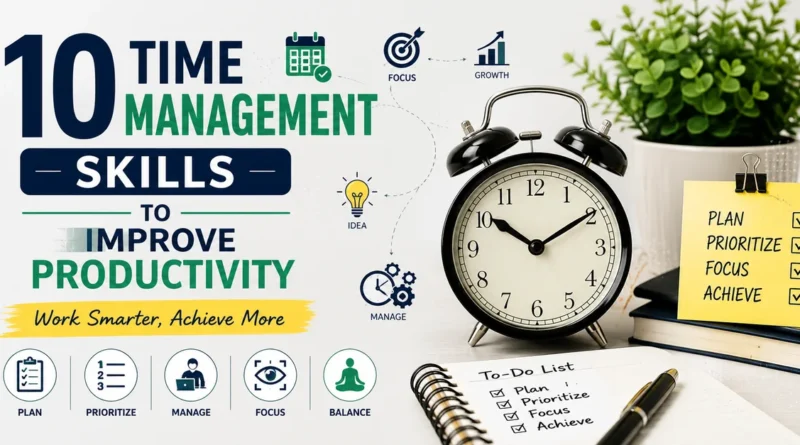
10 Time Management Skills to Improve Productivity
Time is the one resource nobody can create more of. You get the same 24 hours as everyone else, yet some people finish their work early while others struggle to clear even half their to do list. The difference is not luck. It comes down to time management skills.
Good time management helps you reduce stress, meet deadlines, and get more done without burning out. In this article, we will cover the 10 most important time management skills that can boost your daily productivity, along with real examples so you can apply them right away.
Why Time Management Matters for Productivity
Poor time management leads to missed deadlines, rushed work, and constant stress. When you manage your time well, you gain control over your day instead of letting your day control you.
Studies on workplace behavior show that employees who plan their day in advance complete tasks faster and with fewer errors. This is because planning reduces decision fatigue, the mental tiredness that comes from making too many small choices throughout the day.
In short, time management is not just about doing more work. It is about doing the right work at the right time.
10 Time Management Skills You Need to Improve Productivity
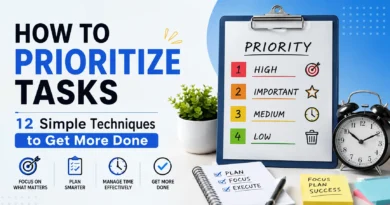
1. Prioritization
Not all tasks carry the same weight. Prioritization means identifying which tasks matter most and tackling them first.
A simple way to do this is the Eisenhower Matrix, which sorts tasks into four groups:
| Category | Description | Action |
|---|---|---|
| Urgent and Important | Deadlines, emergencies | Do it now |
| Important, not Urgent | Long term goals, planning | Schedule it |
| Urgent, not Important | Interruptions, some emails | Delegate it |
| Not Urgent, not Important | Distractions, busywork | Remove it |
Example: A student preparing for exams should prioritize revision (important and urgent) over organizing notes by color (not urgent, not important).
2. Goal Setting
SMART time management skill one of the popular techniques. Vague goals lead to vague results. Use the SMART goal method: Specific, Measurable, Achievable, Relevant, and Time-bound.
Example: Instead of saying “I want to be more productive,” a SMART goal would be “I will finish three client reports by Friday at 5 PM.”
3. Planning and Scheduling
A clear daily or weekly schedule removes the guesswork from your day. Block specific hours for specific tasks instead of working from a random list.
Example: A freelancer might block 9 AM to 11 AM for writing, 11 AM to 12 PM for client calls, and 2 PM to 4 PM for editing.
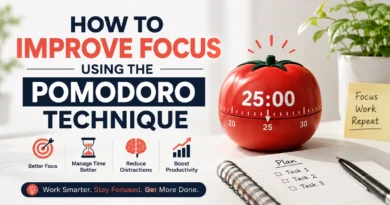
4. The Pomodoro Technique
This method breaks work into 25-minute focused sessions followed by a 5-minute break. After four sessions, take a longer break of 15 to 30 minutes.
The Pomodoro Technique works well for tasks that require deep focus, such as writing, coding, or studying, because it trains your brain to concentrate in short, manageable bursts.
Example: A content writer can complete one blog section per Pomodoro session, making a large project feel less overwhelming.
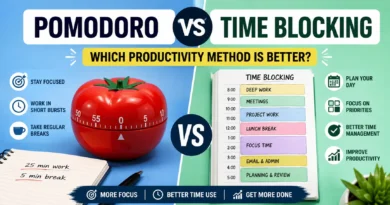
5. Time Blocking
Time blocking is similar to scheduling but goes a step further by assigning every hour of your day to a specific activity, including breaks, meals, and personal time.
Unlike a simple to do list, time blocking shows you exactly when you will do something, not just what you will do.
Example: A project manager might block 10 AM to 10:30 AM strictly for checking and replying to emails, rather than checking them all day long.
6. Delegation
You cannot do everything yourself, and trying to leads to burnout. Delegation means assigning tasks to others who are capable of handling them.
Example: A small business owner can delegate social media posting to a team member while focusing on sales and client relationships.
7. Avoiding Multitasking
Research shows that switching between tasks reduces overall efficiency by up to 40 percent. Single tasking, or focusing on one activity at a time, produces better quality work in less time.
Example: Instead of replying to emails while on a work call, finish the call first and then dedicate a separate time slot to emails.
8. Setting Boundaries
Boundaries protect your time from constant interruptions. This includes saying no to unnecessary meetings, muting notifications during focus hours, and setting clear work hours.
Example: Turning off phone notifications between 9 AM and 12 PM can significantly increase focused output during that window.
9. Using Productivity Tools
Tools like calendars, task managers, and timers help you stay organized without relying on memory alone. Simple online tools can track how long tasks take, count words, or calculate deadlines.
Example: Using a timer tool to track work sessions helps you understand exactly where your hours go each day, making it easier to spot time wasters.
10. Reviewing and Reflecting
At the end of each day or week, take a few minutes to review what worked and what did not. This habit helps you adjust your approach and avoid repeating the same mistakes.
Example: A weekly review might reveal that most interruptions happen between 2 PM and 3 PM, allowing you to plan lighter tasks during that period.
Common Mistakes to Avoid
Even with the right skills, certain habits can quietly ruin your productivity:
- Trying to do too much in one day without realistic limits
- Skipping breaks, which leads to mental fatigue
- Not writing tasks down and relying only on memory
- Checking phone notifications constantly during focus time
- Setting goals without deadlines
Avoiding these mistakes is just as important as learning new skills.
Frequently Asked Questions
What is the most important time management skill?
Prioritization is often considered the most important skill because it ensures your time and energy go toward tasks that create the biggest impact.
How can I improve my time management skills quickly?
Start with one method, such as time blocking or the Pomodoro Technique, and practice it daily for two weeks before adding another skill.
Does the Pomodoro Technique work for everyone?
It works well for tasks needing deep focus, but people with highly interrupted schedules may prefer time blocking or flexible methods instead.
Can multitasking ever be productive?
Multitasking works only for simple, low effort tasks like folding laundry while listening to a podcast. For complex work, single tasking is more effective.
Final Thoughts
Improving your time management skills is not about working longer hours. It is about working with more focus, better planning, and clear priorities. Start with one or two skills from this list, practice them consistently, and slowly add more as they become habits. Over time, small changes in how you manage your day can lead to a major boost in overall productivity.